

I am going to tell you something that no five-star Amazon review will: I had a ROVE R2-4K fall off my windshield at mile marker 214 on I-40 in July. The suction cup let go in about 133-degree cab heat while I was parked at a Pilot outside Amarillo, and the camera hit my dash hard enough to leave a mark. The camera survived, which says something good about the build quality. The footage was fine. My blood pressure was not.
That is the honest starting point for this review. I have been running the ROVE R2-4K dual dash cam on my Peterbilt 389 for several months now, doing OTR runs between Dallas and the California ports. I am not here to recite the spec sheet. I am here to tell you what the listing skips, what surprised me in a bad way, and what I genuinely like about this camera after putting real miles on it.
The Quick Verdict
Excellent front footage and good rear coverage, but summer cab heat will test the suction mount, the WiFi app needs patience to pair, and parking mode requires a hardwire kit that does not come in the box.
Amazon Check Today's Price →Your footage is worthless if your cam is on the floor when the crash happens.
The ROVE R2-4K runs 4K front, 2K rear, STARVIS 2 night sensor, and comes with a 128GB card included. Check today's price on Amazon before you roll out without one.
Amazon Check Today's Price on Amazon →How I've Been Running It (and What I Changed)
My setup: front camera on the windshield, rear camera wired to a bracket above my rear window looking back over the trailer. I run dedicated runs, mostly freight, so I am in the cab or staged somewhere hot for long stretches between loads. That is the real test for a dash cam in a semi truck, and it is a different test than what a car driver runs.
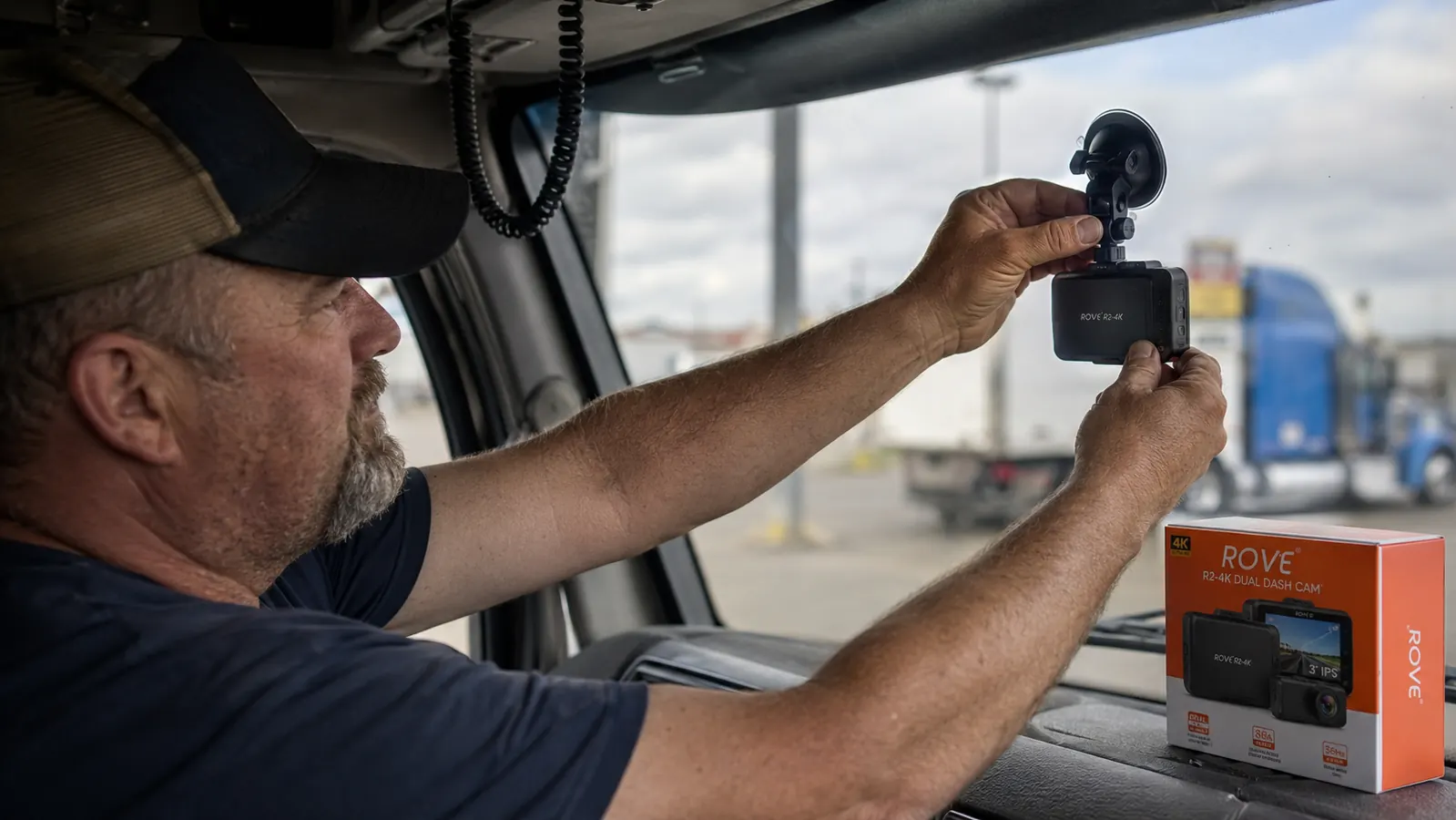
First thing I did after the Amarillo incident was ditch the suction cup mount. I switched to the 3M adhesive mount included in the box, used the supplied alcohol wipe to clean the glass first, and pressed it for a full 60 seconds. That mount has not moved since, through West Texas summer heat, Colorado mountain cold, and a stretch of rough chip-seal outside Albuquerque that rattled everything in the cab. If you are in a truck and running summer heat, skip the suction cup on day one. Go straight to the adhesive.
I also switched my microSD card. The 128GB card that came in the box started throwing errors by late June. I replaced it with a Samsung PRO Endurance 128GB, which is designed specifically for continuous-loop video recording in high-heat environments. No errors since. The ROVE-branded card that comes in the box is fine for most users, but if you are in a summer cab regularly hitting 120-plus degrees, get yourself the Samsung PRO Endurance and do not think twice about it.
The 4K Claim: What It Actually Means for a Trucker
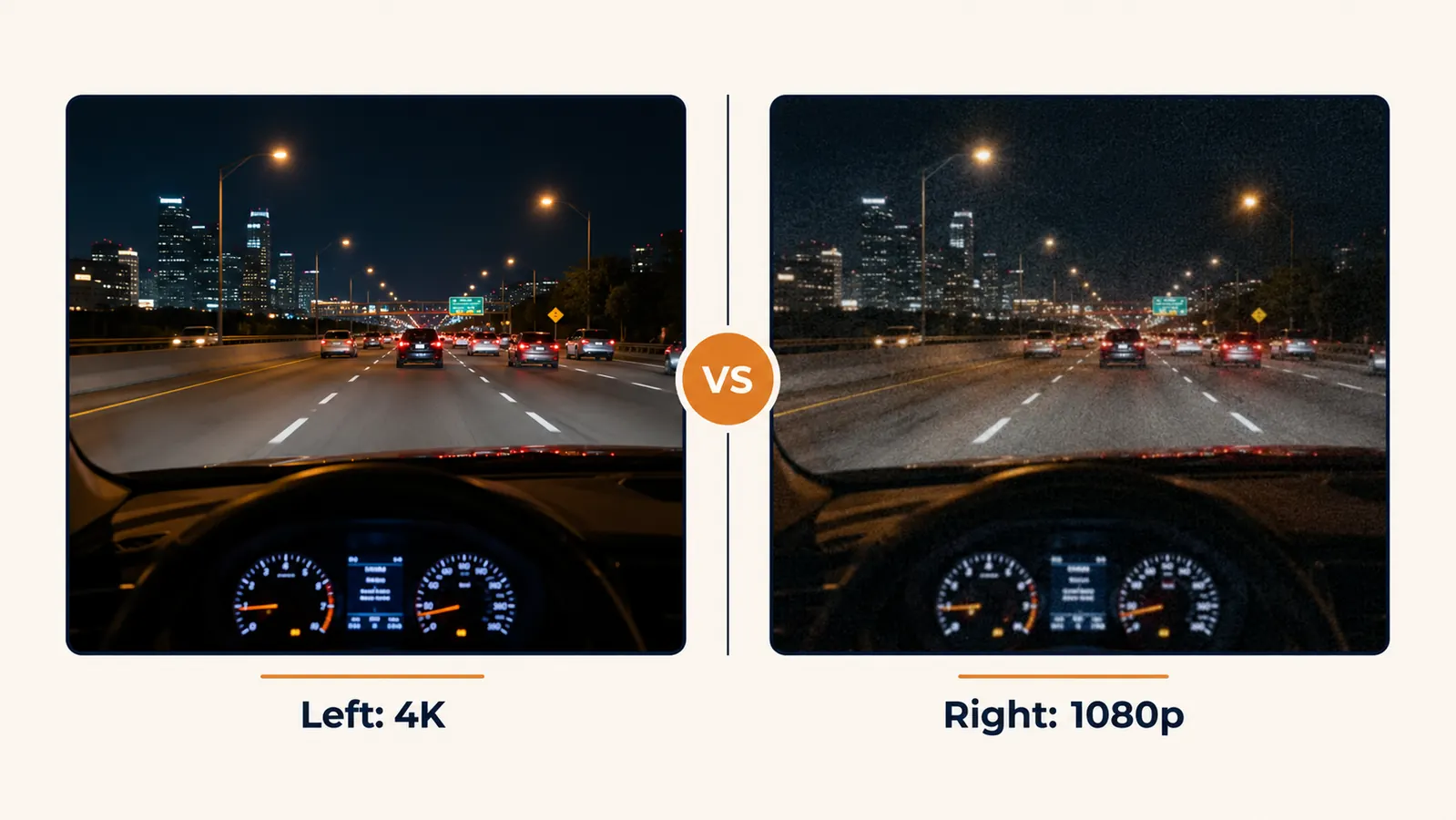
Let me be straight with you. When ROVE says 4K, they mean 3840x2160 on the front camera at 30 frames per second. That is legitimate 4K. It is not marketing math where they stitch two 1080p sensors and call it 4K. The front camera is a genuine 4K sensor with a Sony STARVIS 2 chip, and the footage reflects it.
What does that actually buy you? It buys you readable license plates at highway distance. That matters when a four-wheeler cuts you off and keeps rolling. At 1080p or even 1440p, plates blur past a certain speed and distance. At 4K, you can pause the footage and read a plate that passed you at 75 mph with about 100 feet of distance. I tested this specifically because plate legibility is the whole point of having a dash cam for liability purposes.
The rear camera is 2K, not 4K, and that is the right call. The rear camera on a dual system is primarily tracking what is behind you at the trailer or at a dock. 2K is more than enough for that. Running full 4K on both cameras would eat cards faster and generate heat. ROVE made a sensible engineering decision there and I would not trade it for dual 4K even if that were offered.
At 4K, you can pause and read a plate that passed you at 75 mph from 100 feet away. That is the whole point of having one of these.
Night Vision: Honest Numbers
The STARVIS 2 sensor from Sony handles low light better than anything I have run before at this price. I do a lot of night miles on I-10 through the desert and on some of the darker stretches of I-70 through Kansas, where there are literally no lights for 40-mile stretches. The front camera captures headlight range cleanly, reads lane markers, and keeps oncoming headlights from blowing out the whole frame. That last part is the night-vision problem most dash cams have, and the STARVIS 2 chip handles it with what ROVE calls HDR processing.
Where night vision gets honest: the rear camera is noticeably softer in real darkness. If you are parked at a dark rest area without lot lights, the rear feed is going to be grainy. It is still functional, and it still picks up motion and vehicle shapes, but do not expect the rear to match the front after midnight on a dark road. For parking situations, the front camera is where the useful footage lives.
Summer Heat: The Real Problem Nobody in a Car Would Know About
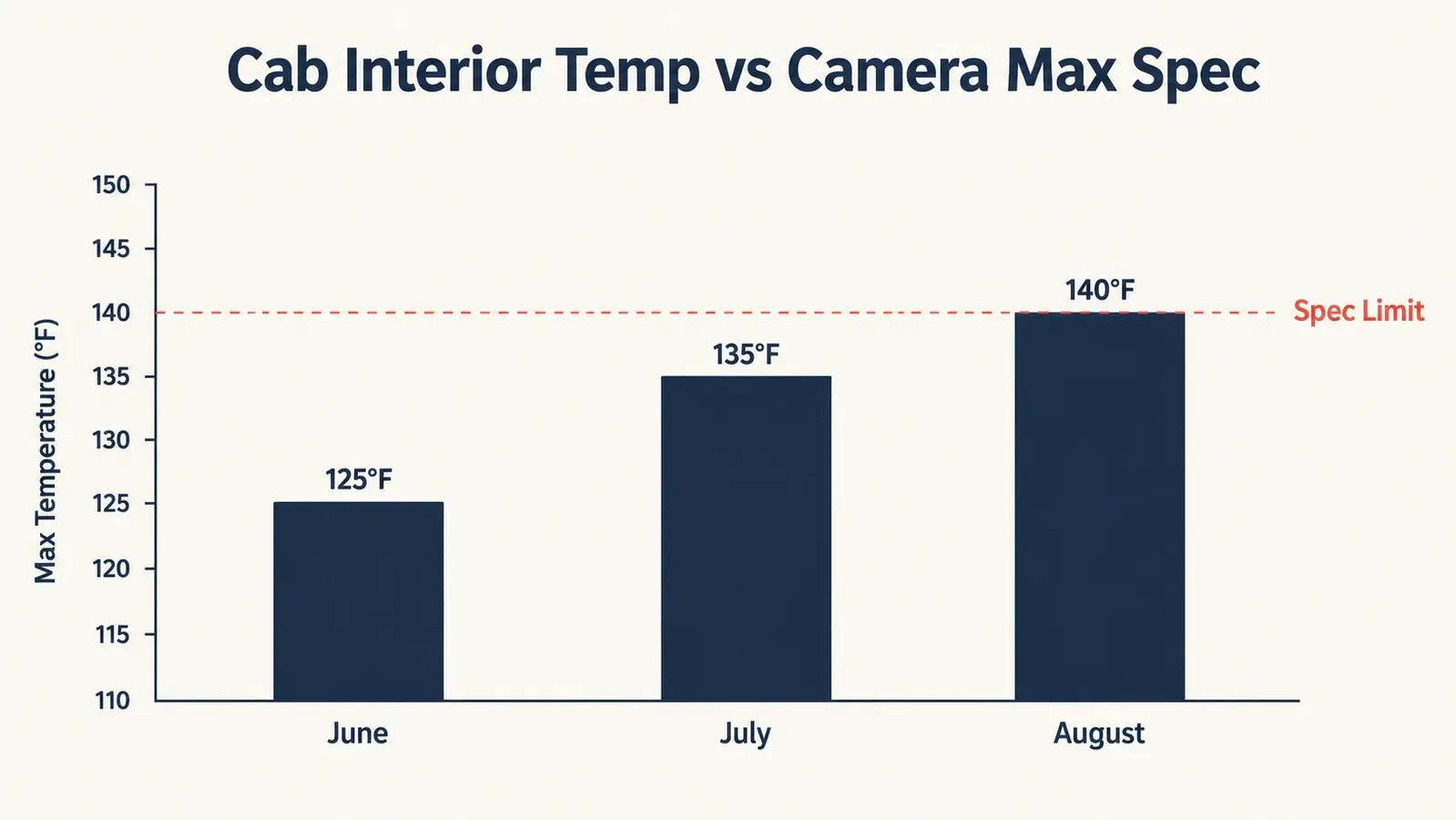
This is the section that most reviews skip because most reviewers are not sitting in a black-cab semi on a July afternoon in the Texas Panhandle. Cab interior temperatures in a parked semi with the engine off can hit 130 to 140 degrees Fahrenheit. That is not speculation. I have a cheap thermometer on my dash, and I have seen 136 degrees on a clear afternoon in Lubbock with the shades up.
The ROVE R2-4K is rated to operate up to 140 degrees Fahrenheit, and to store up to 185 degrees. That operating spec is right at the edge of what a parked cab will hit on a bad day. What I found in practice: the camera goes into a thermal protection mode and stops recording when it gets close to the limit. This happened to me twice in July. Both times, it resumed recording on its own once I started the truck and the AC brought the cab temperature down. It did not lose any footage already recorded, and it did not damage the unit. But if you expect continuous coverage through a long parked-engine-off situation in extreme summer heat, you need to know this is a real possibility.
The Samsung PRO Endurance card helps here too. Standard TLC flash starts getting unreliable above 85 degrees Celsius, which is 185 Fahrenheit. The PRO Endurance uses a different NAND design for sustained heat. Your camera's thermal protection is likely to kick in before the card fails, but why put both at risk. Use the right card.
The WiFi App: Real Talk on Pairing
The ROVE app is called RoveCam and it is available for both iOS and Android. The 5GHz WiFi in this camera is legitimately faster than the older 2.4GHz-only models. Downloading a 2-minute 4K clip takes about 45 seconds over the WiFi connection, which is usable. The problem is getting the initial pairing to stick.
Here is what I had to figure out that the quick-start guide does not spell out clearly. Your phone needs to be connected to the camera's WiFi network, not your cellular data, during the pairing process. Sounds obvious, but a lot of phones will automatically switch back to LTE if the WiFi network it is connected to does not have internet access, which the camera's own hotspot obviously does not. On iPhone, you have to tap 'Use Without Internet' when iOS asks you about this. On Android, you may need to turn off the 'Switch to Better Network' setting before you start. Once I figured that out, the pairing has been reliable.
The GPS tracking in the app is useful. You get speed overlay on the footage and a map track of the route. If you are an owner-operator and you want a second record of your route to go alongside your ELD data, this is a free bonus. The app also lets you adjust loop recording length, sensitivity settings for the G-sensor, and parking mode thresholds. It is not a perfect app, but it covers the basics well.
Parking Mode and the Hardwire Problem
Parking mode is the feature that records when the camera detects motion or an impact while the truck is off. It is genuinely useful at a terminal where you are leaving the rig overnight, or at a truck stop where lot break-ins happen. The problem is that parking mode requires a constant power source when the truck is off, and the included power cable only works when the ignition is live.
To run parking mode, you need a hardwire kit. ROVE sells one, and it is not included in the box. The hardwire kit taps into a fuse that stays live when the ignition is off, typically an accessory fuse in your truck's fuse panel. If you are handy with a meter and know your fuse box, this is a 45-minute job. If you are not, any shop that does upfitting or 12V installs can do it in about an hour. It is worth doing. But the listing does not say this in plain language, and a lot of buyers assume parking mode works out of the box. It does not, without the additional kit.
What I Liked
- Genuine 4K front footage with Sony STARVIS 2 sensor, plates readable at highway speed
- 2K rear camera is solid quality for dock and trailer coverage
- Night vision handles headlight glare and dark roads better than cameras at this price
- 5GHz WiFi downloads footage quickly once you get the app paired correctly
- GPS route tracking included at no extra cost
- Built well enough to survive a suction-cup fall off the dash without breaking
- 128GB card is included in the box, which most competitors do not include
Where It Falls Short
- Suction cup mount is unreliable in extreme summer cab heat, go straight to adhesive
- Thermal protection mode can pause recording in 130-plus-degree parked cab situations
- Parking mode requires a hardwire kit that is not included and not clearly disclosed in the listing
- App pairing requires disabling automatic network switching on your phone, which the manual skips
- Included microSD card may develop errors in sustained high-heat use, upgrade to Samsung PRO Endurance
- Rear camera noticeably softer than front in real darkness
Who This Is For
This camera is well suited for owner-operators and company drivers who want real 4K footage for liability protection, do not need parking mode out of the box, and are willing to spend 30 minutes sorting out the app the first time. If you run the Sun Belt corridor and park in summer heat regularly, buy the Samsung PRO Endurance card on the same order and use the adhesive mount from the start. If you run year-round in the northern states where heat is not a factor, the included card will probably serve you fine for a long time.
Who Should Skip It
If you are a company driver who cannot modify your truck's fuse panel, you will not get parking mode working without shop help, and your company may not authorize that kind of electrical work. In that case, a simpler camera with a capacitor instead of a battery and a straightforward plug-in setup might be less trouble. Also, if you are not comfortable with the WiFi pairing process or do not plan to pull footage via the app regularly, the extra cost for the 4K model over a solid 1080p unit may not pay off for your situation.

If the camera is not recording when the incident happens, you paid for nothing.
The ROVE R2-4K is a genuinely capable dash cam for OTR work. Use the adhesive mount, grab a Samsung PRO Endurance card, and get the hardwire kit if you want parking coverage. Everything else about this camera earns its price. Check availability on Amazon before you leave the yard.
Amazon Check Today's Price on Amazon →