

Short answer: get the ROVE R2-4K. If you are an owner-operator or run a commercial vehicle regularly, the ROVE was designed with trucks in mind and that shows in ways that matter when you actually need the footage. The Vantrue E1 Lite is a well-built camera, and it deserves credit for that, but there are a few gaps that become real problems when you are hauling 80,000 pounds down I-70 and some four-wheeler decides to do something stupid.
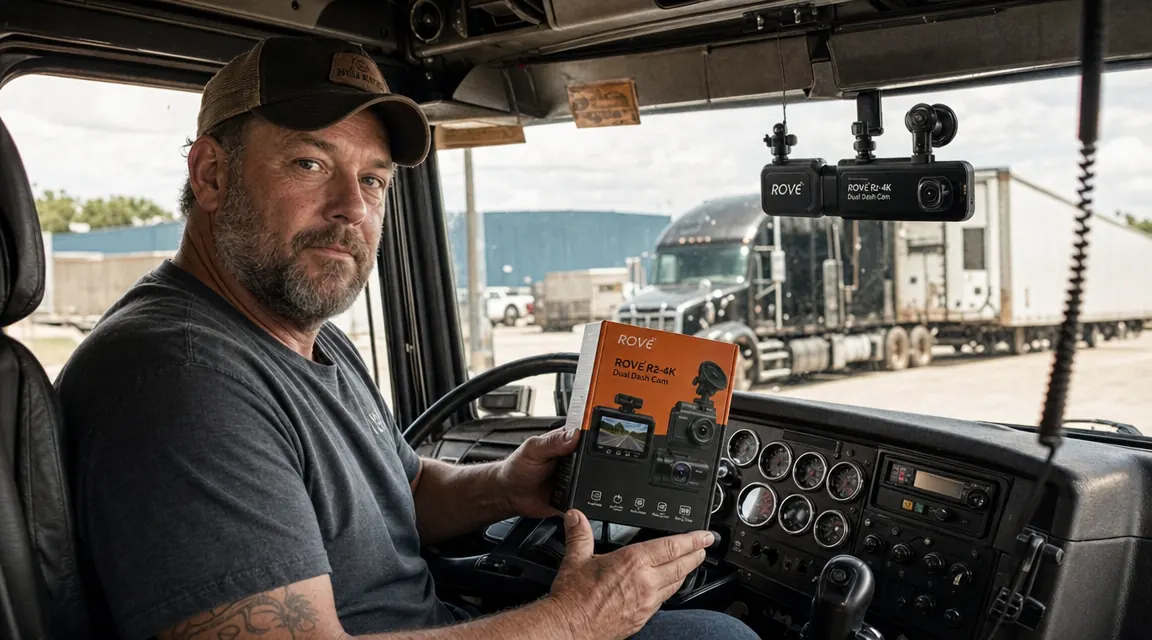
I have run both cameras. The ROVE R2-4K dual dash cam went in my Freightliner Cascadia cab about eight months ago and it has been running without a complaint since. The Vantrue E1 Lite I tested on a company truck for about six weeks before we pulled it. Here is the side-by-side breakdown.
| Feature | ROVE R2-4K (Left) | Vantrue E1 Lite (Right) |
|---|---|---|
| Front resolution | 4K UHD (3840x2160) | 1080p Full HD |
| Rear resolution | 1080p Full HD | 1080p Full HD |
| Night vision sensor | STARVIS 2 (Sony) | STARVIS (Sony gen 1) |
| GPS included | Yes, built-in | No (add-on purchase) |
| WiFi | 5G dual-band | 2.4G only |
| Included storage | FREE 128GB SD card | No card included |
| Commercial vehicle mode | Yes, optimized for trucks | No dedicated mode |
| Loop recording | Yes, auto-overwrite | Yes, auto-overwrite |
| Parking mode | Yes (requires hardwire kit) | Yes (requires hardwire kit) |
| Current price (approx) | $129.99 | $89-100 (varies) |
| Amazon rating | 4.4 stars, 11,800+ reviews | 4.3 stars, fewer reviews |
Where the ROVE R2-4K Wins
The front camera resolution is the first thing anyone notices when they pull footage. The ROVE shoots 4K on the front lens using a Sony STARVIS 2 sensor, which is the second generation of Sony's low-light imaging tech. What that means in the real world is that at 3 AM on a dark stretch of I-80, you can read a license plate at a distance where the Vantrue starts to break down into grain. That is not a small thing. If you ever have to hand footage to an insurance adjuster or an attorney, readable plates and readable road signs are what close a case in your favor.
The bundled 128GB SD card is a bigger deal than it sounds. The Vantrue ships without one, so you are immediately looking at another purchase before you even mount the camera. At 4K resolution, a 64GB card fills up faster than you expect on a long run. ROVE shipping a 128GB card in the box means you are covered before you even start wiring it up. For a driver who does not want to mess around with compatibility research on SD cards, this alone saves a trip to a Best Buy or a guessing game on Amazon.
Built-in GPS is standard on the ROVE and optional on the Vantrue. GPS data is embedded in the video file and shows your speed and position at every moment. If someone says you were going 75 in a 55 when a collision happened, the footage with GPS overlay settles it. The Vantrue charges extra for a GPS module that you have to buy separately and keep track of. When you are already managing hours of service, weight slips, and inspection paperwork, you do not want another accessory sitting in your door pocket that you might forget to plug in.
Where the Vantrue E1 Lite Wins
Price is the obvious one. The Vantrue runs about $89 to $100 depending on where you catch it, which is a real $30 to $40 savings over the ROVE. If you are a company driver and the truck is not yours, or if you drive a leased truck you will be turning in within the year, spending less on a solid camera makes sense. The Vantrue E1 Lite is not a throwaway cheap option. It records front and rear in 1080p, loop records automatically, and the app works fine on Android or iPhone. It is a legitimate camera.
The Vantrue also tends to be a little more compact in its mounting footprint, which matters if your cab already has gear stacked around the center console or if your fleet has strict rules about windshield obstructions. Some fleets have DOT inspection guidelines that get touchy about camera placement, and the Vantrue's smaller profile gives you a bit more flexibility on mount position without blocking sightlines.
Your CDL is worth more than the $40 you'd save on the other camera.
The ROVE R2-4K comes with 128GB storage included, built-in GPS, and STARVIS 2 night vision. One incident where you need clear plate-readable footage and this camera pays for itself five times over.
Amazon Check Today's Price on Amazon →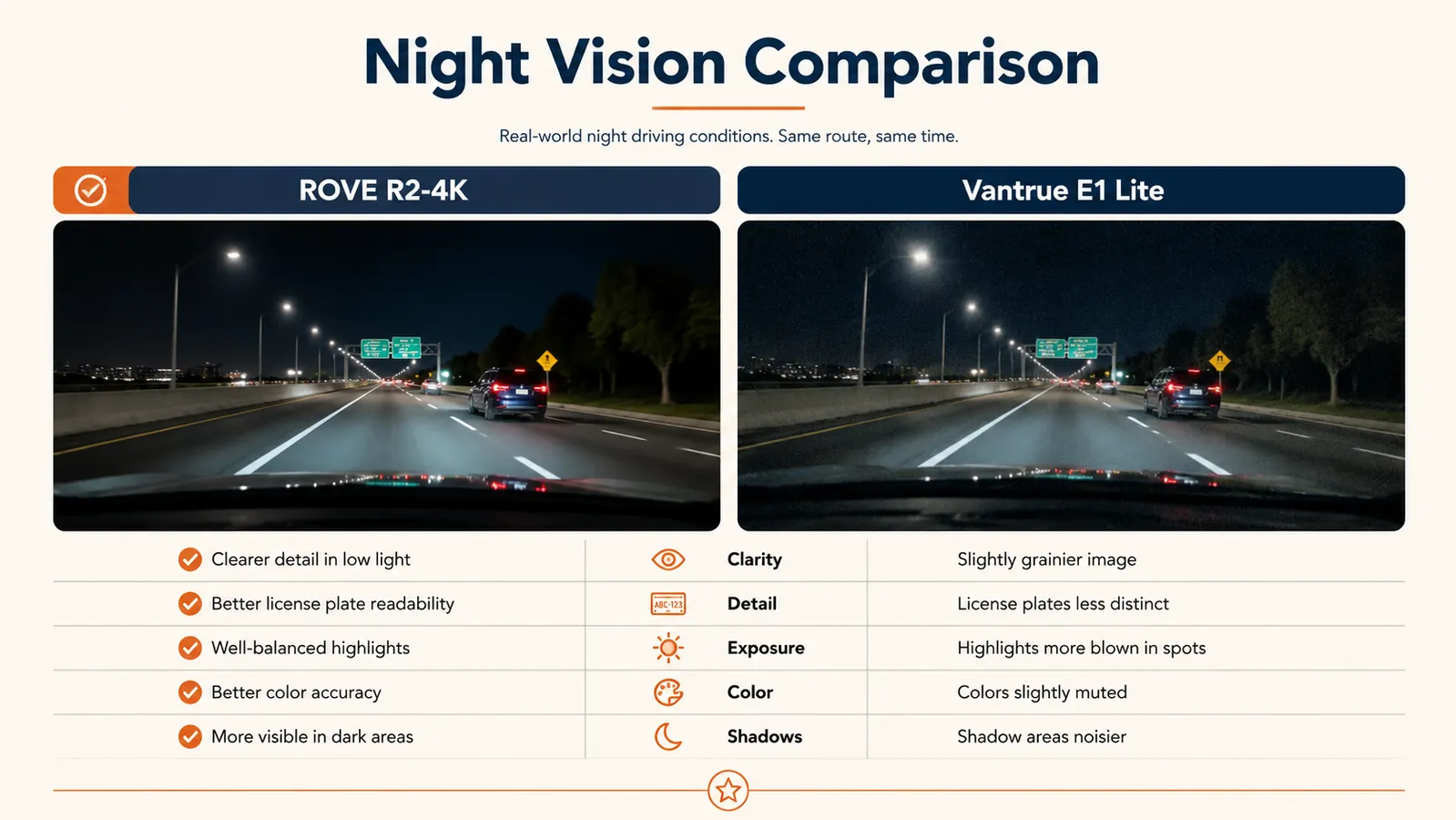
Night Vision: The Difference That Counts at 2 AM
Both cameras use Sony STARVIS sensors. The ROVE uses the second-generation STARVIS 2 and the Vantrue uses first-generation STARVIS. On paper that sounds like a minor spec bump, but the low-light performance gap is visible when you run footage side by side. The STARVIS 2 pulls in more light at the same aperture, which means cleaner color rendering when you are under sodium vapor lamp light at a dark interchange or rolling through a construction zone with irregular lighting. If you run a lot of overnight miles, this is the most meaningful hardware difference between the two cameras.
A dash cam is not something you think about until the day you need it. That day, the quality of the sensor is the only thing that matters. Get the better sensor.
WiFi App and Footage Access
The ROVE uses 5G dual-band WiFi. The Vantrue uses 2.4G only. In practical terms, pulling 4K footage off the ROVE via the app is noticeably faster than pulling 1080p footage off the Vantrue. When you are parked at a customer dock with 20 minutes and you need to grab a clip, connection speed matters. The ROVE app takes a bit of learning at first, but once you have done it twice it is straightforward. The Vantrue app is simpler but occasionally drops the WiFi connection mid-transfer on Android, which is a nuisance when you are on a schedule.
Neither camera is going to win awards for its companion app experience. Both do the job. The ROVE app gives you GPS track playback overlaid on a map view, which is useful if you want to review a trip route along with the footage. The Vantrue app is more basic. For a driver who just wants to pull a clip and send it to their dispatcher, either works fine. For a driver who wants GPS data tied to footage, the ROVE is the only one that can do it without buying an extra module.

Installation and Mounting in a Class 8 Cab
Both cameras mount to the windshield via suction cup or adhesive mount. The ROVE ships with both options. In a Class 8 cab, you have a different windshield angle and a much larger glass surface than a passenger car, so placement matters more. The ROVE's adjustable mounting arm gives you enough range to get the front camera angled correctly even on steep windshield pitches common in older Peterbilts and Kenworths. The rear camera runs via a long cable to the back of your cab, which you route along the headliner. Neither camera is hardwired out of the box for parking mode, which requires a separate hardwire kit for either unit. That is normal for cameras in this price range.
Loop recording on both cameras is automatic. When the SD card fills, the oldest footage overwrites. You do not have to manage files manually. On a 128GB card at 4K, the ROVE retains roughly 18 to 20 hours of front footage. That covers most situations where you would need to recover a clip. If you want longer retention, you can drop the front camera resolution in the settings, which extends loop time considerably.
Who Should Buy Which
Buy the ROVE R2-4K if you are an owner-operator, if you lease your truck, or if you run solo OTR and are personally responsible for your CDL and your insurance. The 4K front lens, STARVIS 2 sensor, built-in GPS, included 128GB card, and 5G WiFi all add up to a camera that protects you better when you need footage to be clear and complete. At $129.99 the ROVE R2-4K is priced fairly for what it delivers. Given that a single disputed insurance claim or a wrongful citation can cost you thousands, this is not an area to buy cheap.
Buy the Vantrue E1 Lite if you are a company driver on a fleet that is price-sensitive, if you drive a truck you will be turning back in, or if your primary concern is basic front-and-rear coverage and you already have an SD card in the right capacity. It is a solid camera that records reliably. You will need to buy a GPS module separately if you want that data embedded in footage, and you will need a good Class 10 U3 SD card, which adds back some of the initial savings. Factor that in before you assume the Vantrue is significantly cheaper all-in.
For most drivers reading this, the ROVE is the right call. The gear you use to protect yourself on the road is not where you cut corners. If you want to go deeper on the long-term performance of the ROVE R2-4K across different weather and road conditions, read the full review at the link below.
More coverage, better night vision, GPS included, 128GB card in the box.
The ROVE R2-4K dual dash cam is the pick for owner-operators who need footage they can actually use. Check today's price on Amazon and see if there is a coupon running.
Amazon Check Today's Price on Amazon →