
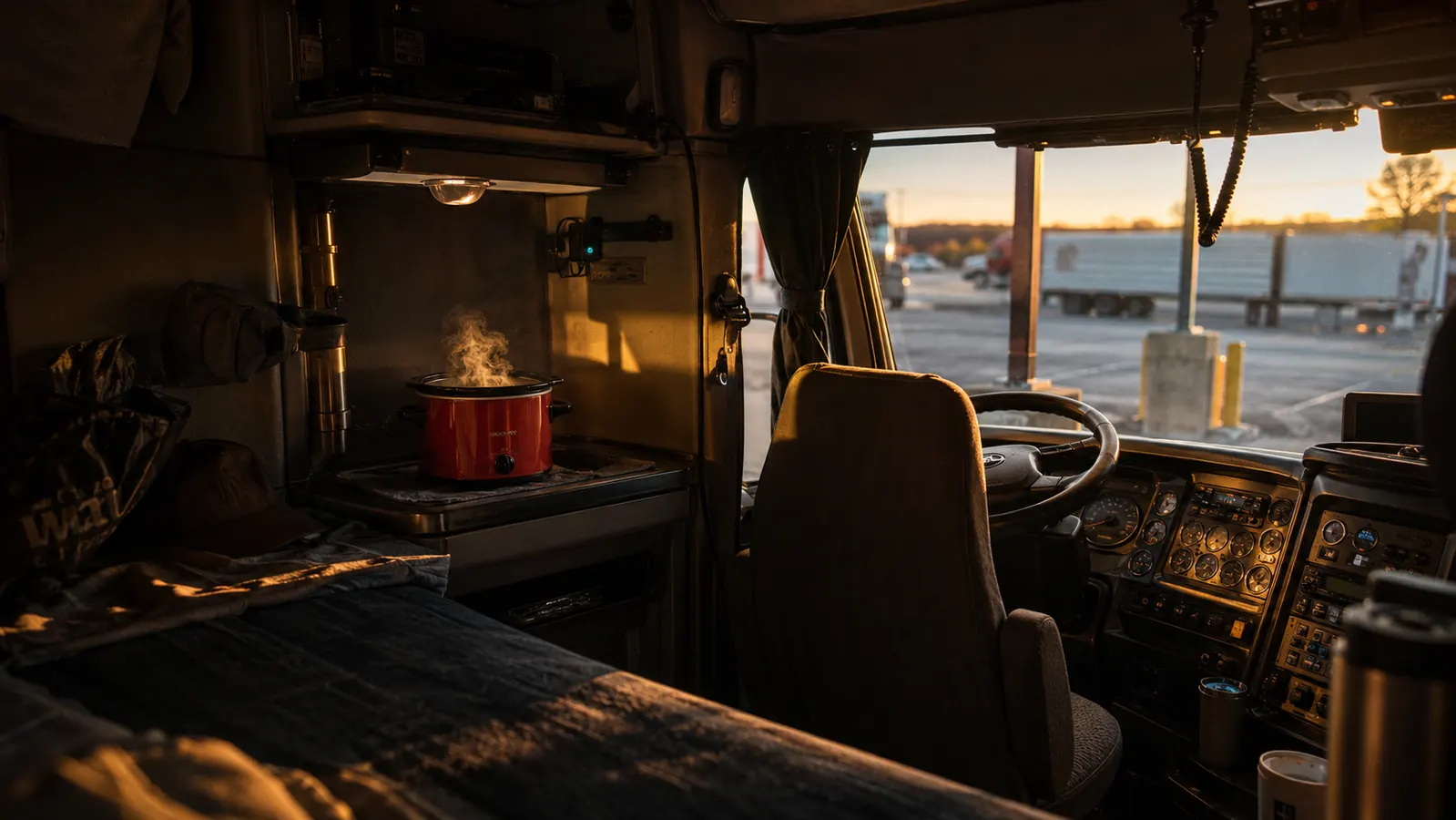
Most drivers I know spend somewhere between $60 and $100 a week on truck-stop food. I was right there with them for the first several years. Greasy burgers, breakfast burritos that have been sitting under a heat lamp since 4 AM, and $4 bottled water because you forgot yours. Then I started doing the math on what that adds up to over a year, and I decided it was time to figure out how to actually cook in the cab.
The good news is you do not need a kitchen. You need a 12V outlet, something to put food in, and about ten minutes of prep time before you start rolling. I have been cooking hot meals in my cab for going on three years now using nothing but a RoadPro 12V slow cooker and a small cooler. It works. This guide covers the exact steps I follow, what to buy, what to skip, and what I wish someone had told me the first week I tried this.
The 12V slow cooker that makes cab cooking actually practical
The RoadPro RPSL-350 runs off your cigarette lighter, holds 1.5 quarts, and cooks a full meal while you are putting miles down. Rated 4.3 stars from over 700 drivers who eat real food on the road.
Amazon Check Today's Price on Amazon →Step 1: Know What Power You Actually Have in the Cab
Before you buy a single appliance, understand your power situation. Most semi trucks have at least one standard 12V cigarette-lighter outlet on the dash plus one or two in the sleeper. Some newer rigs have a 120V inverter outlet in the sleeper as well. The 12V outlets are wired directly to the battery, which means they draw power even when the engine is off. This matters.
A 12V slow cooker draws around 140 to 180 watts and typically runs 4 to 6 amps. That is well within what a single 12V circuit will handle, and it will not cook your battery if the engine is running. If you are at a truck stop with the engine off, do not leave the cooker running for hours. You will drain the batteries fast enough to need a jump. The safe habit is to start your meal when you are about to hit the road so the alternator is doing the work.
If your rig has an APU or an inverter with a proper house battery bank, you have more flexibility. But for the basic setup this guide covers, assume you are running off the engine and plan accordingly.
Step 2: Get the Right Cooker
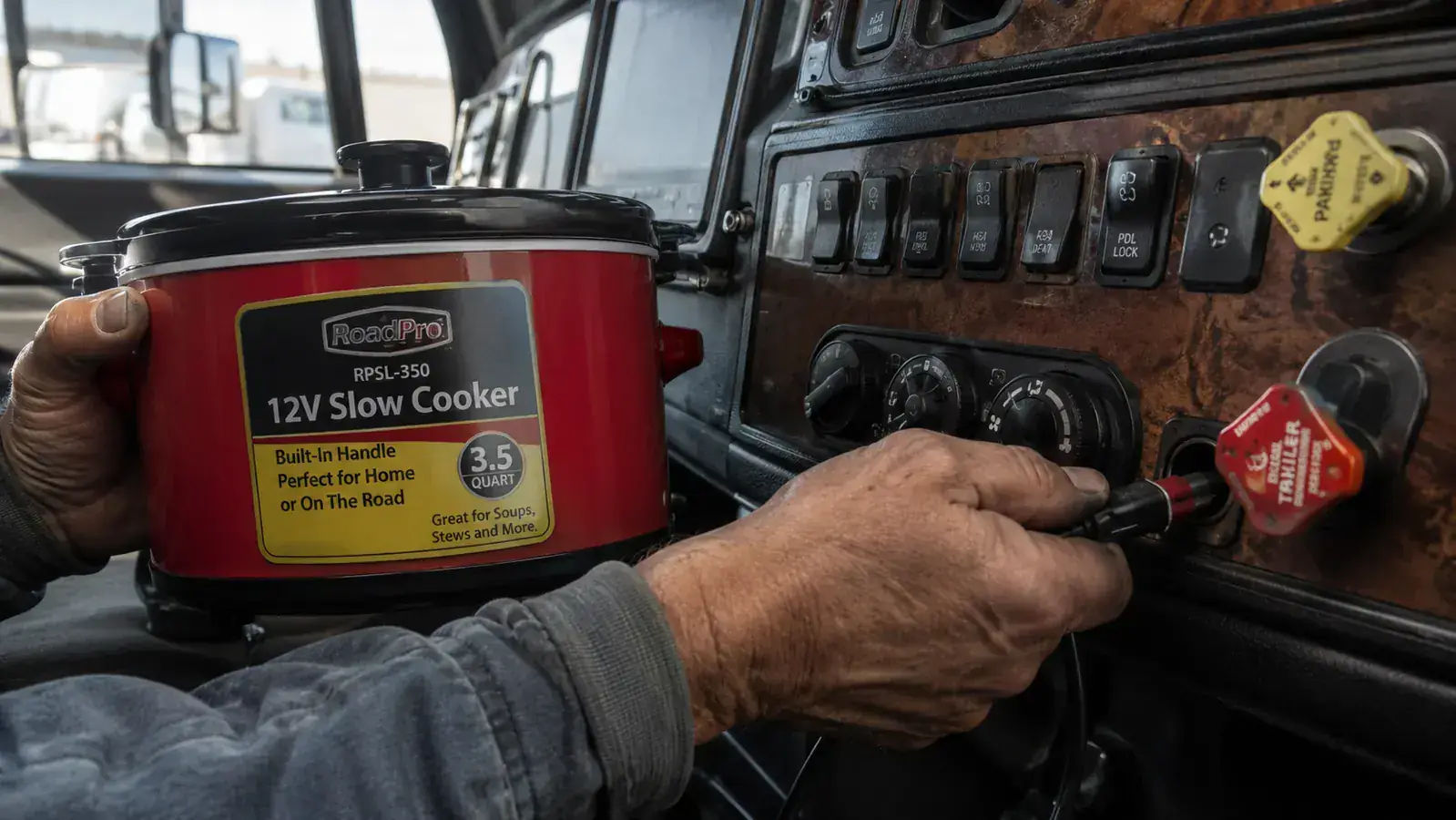
There are three categories of 12V cooking appliances out there: lunchbox-style heaters (just rewarm food, do not actually cook raw ingredients), 12V kettles (for hot water, oatmeal, ramen, instant coffee), and 12V slow cookers (cook raw food from scratch). For real cab cooking, you want a 12V slow cooker.
The one I use and recommend to anyone who asks is the RoadPro RPSL-350. It is a 1.5-quart unit that plugs into a standard 12V cigarette-lighter port. The crock holds enough for a solid single-driver meal, it has a proper ceramic insert that is easy to clean, and it comes with a lid that has a vent hole so pressure does not build on bumpy roads. It runs around $32 at current pricing. I have had mine for over two years with zero problems. The 12V plug is the standard lighter plug, so it fits every semi truck I have been in.
What you will notice compared to a home slow cooker is that it takes longer. A home Crock-Pot runs on 120V at 200 to 300 watts. The RoadPro runs at 12V, which works out to roughly 140 watts. Plan for about 8 to 10 hours on a long cook like a pot roast, or 4 to 5 hours for something like chicken thighs in broth. If you are running a 500-mile day, your meal is ready when you park. That is the system.
Step 3: Set Up a Simple Cold Storage System
You cannot cook from scratch without ingredients. That means you need some kind of cold storage in the cab. The options are a 12V electric cooler (good, runs about $60 to $90), a quality foam cooler with ice (cheap, works fine for 2 to 3 days between ice runs), or a quality insulated soft-sided cooler that you reload at truck stops with bagged ice.
I spent the first year using a 48-quart foam cooler. It worked. I would restock with a bag of ice at truck stop fuel stops every other day. Now I use a 12V electric cooler and it is genuinely better since I do not burn through ice, but the foam cooler system is a fine starting point if you are not ready to spend more money.
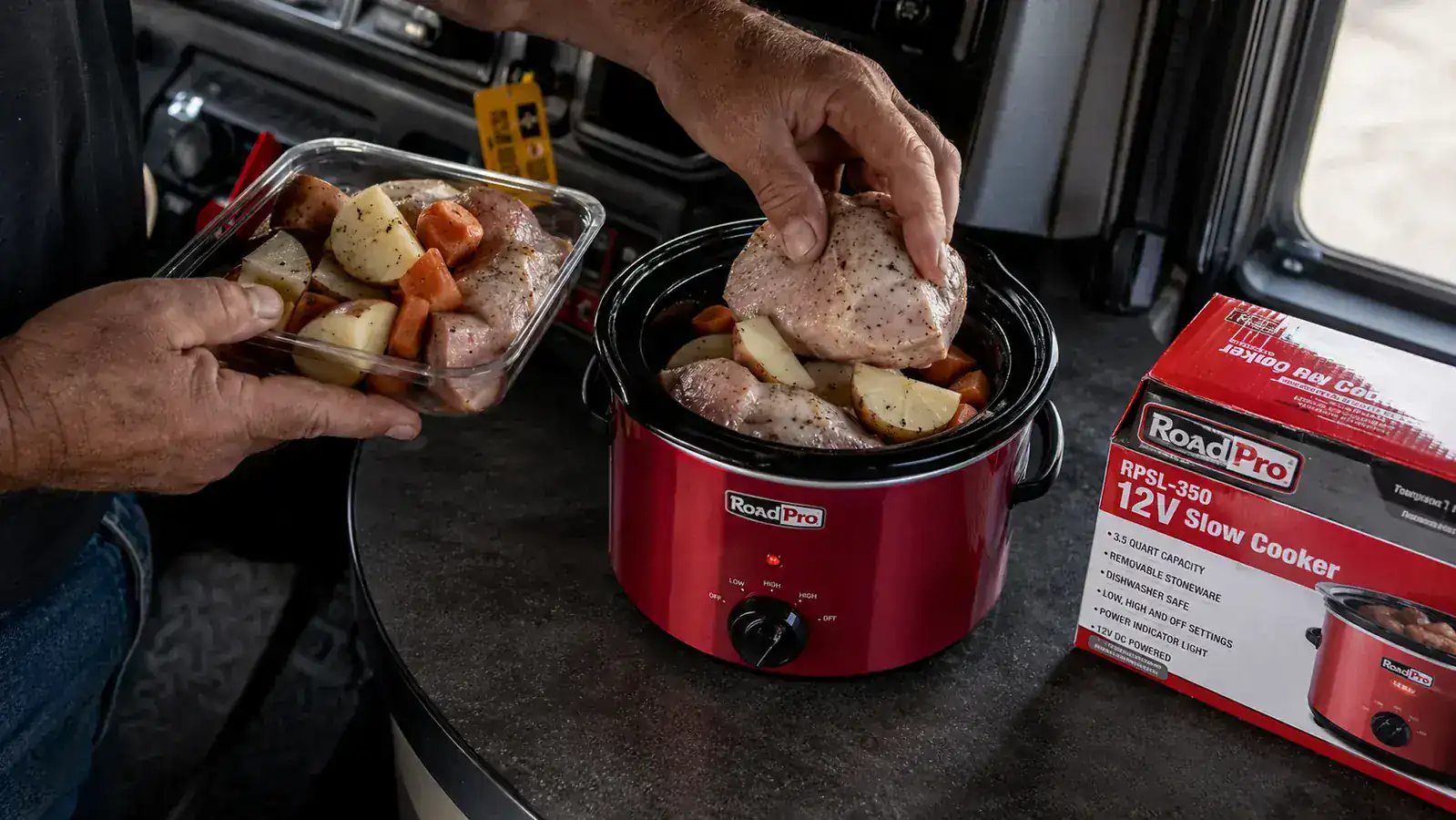
For ingredients, I keep the cooler stocked with basics: chicken thighs, a few pork loin chops, some pre-chopped vegetables my wife puts in zip-lock bags on Friday night when I swing through the house. For truckers without that setup, most truck stops sell basic produce and protein. Dollar General along the interstate is also underrated for pantry staples like canned beans, broth, and rice.
Step 4: Load the Cooker the Night Before or at the Start of Your Shift
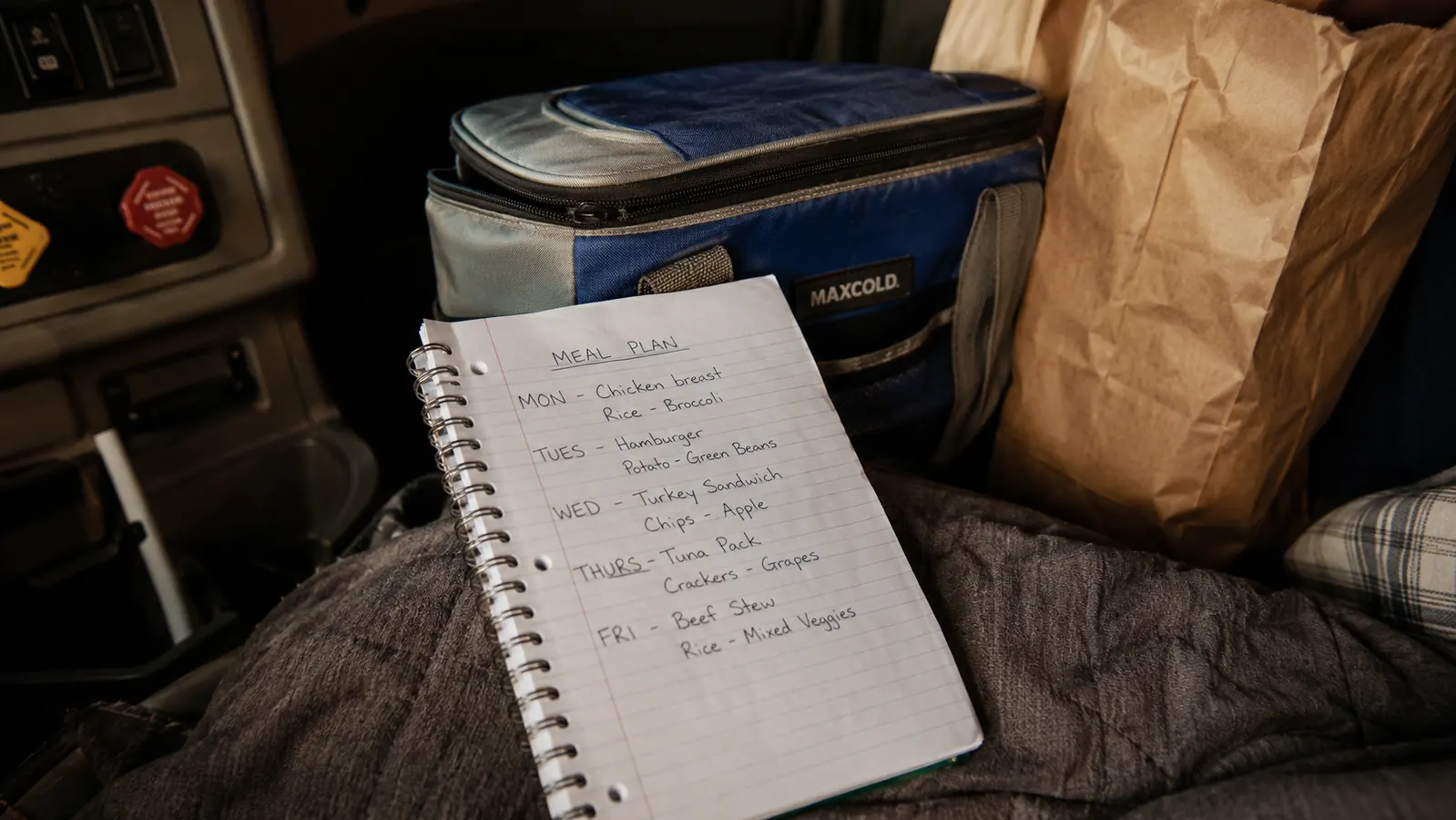
This is the step that makes or breaks the whole system. If you try to figure out what to cook when you are hungry and tired at a rest area, you will give up and drive to the nearest Subway. The move is to load the cooker before you start moving.
My standard routine: the night before a long run, I pull the ceramic insert out of the cooker, put in the ingredients for tomorrow's meal, lid it, and store it in the cooler overnight. In the morning I pull it out, set it in the cooker housing on my counter shelf, plug it in, and drive. By the time I hit my first fuel stop five or six hours later the food smells good. By the time I park for my 30-minute break it is ready to eat.
Recipes that work well in a 12V slow cooker: chicken thighs in salsa, beef stew with potatoes and carrots, pork and beans, white bean and sausage soup. Recipes that do not work well: anything that needs to stay at a rolling boil, anything with pasta added early (goes to mush), anything requiring a dry roast. Stick to brothy or saucy dishes and you will be happy.
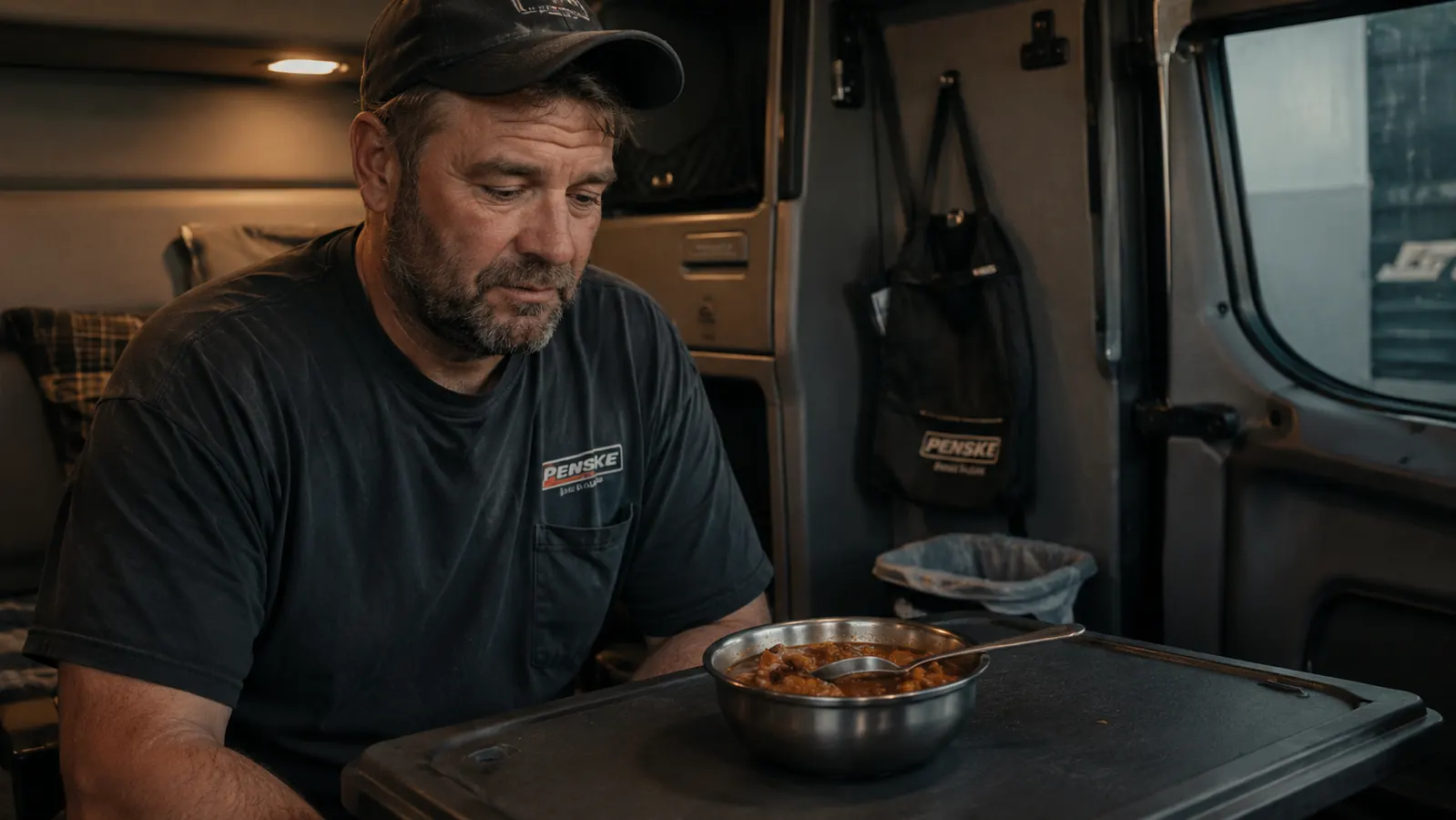
I loaded it before I left the terminal Tuesday morning. By the time I crossed into Ohio, the chicken and potatoes were done. Ate a real meal at a rest area instead of paying $13 for a gas station sandwich. That is what this thing does for you.
Step 5: Keep the Cooker Secured So It Does Not Become a Projectile
This one matters more than people think. A ceramic slow cooker full of hot liquid is not something you want sliding off a shelf when you hit a pothole on I-80. Before I figured out a proper spot for mine, I had one lid pop off on a rough patch of highway in Indiana. Chicken broth everywhere. Learned that lesson once.
The best placement is on a shelf that has a lip or a non-slip mat underneath the cooker. I use a small piece of that rubberized drawer liner material cut to fit the shelf. It grips the bottom of the crock housing and does not move. Some drivers use a velcro strap around the unit. Either works. The point is to treat it like anything else in your cab that you do not want turning into a hazard at highway speed.
Also worth mentioning: keep the cord managed. The RoadPro cord is long enough to reach most dash outlets from a counter shelf, but a loose cord running across the floor is a trip hazard when you are climbing in or out of the sleeper in the dark. A few cord clips from the hardware store fix that for about $2.
What Else Helps
Once you have the slow cooker system running, a few additional items make cab cooking genuinely comfortable. A 12V kettle is useful for morning coffee or oatmeal without having to cook a full meal. A set of stainless camp bowls and a decent spork take almost no space. A small cutting board for prep work on your counter shelf. And a roll of paper towels you actually replace when they run out instead of using the same rag for two weeks.
For longer runs where I want variety, I bring a second zip-lock bag of meal ingredients so I can cook something different the next day without a grocery stop. My wife figured out that if she freezes the raw chicken thighs in the marinade, they double as an ice pack in the cooler for the first day, then they are thawed and ready to load into the cooker by day two. That trick alone saves me at least one grocery detour per run.
The payoff is real. Most drivers who do this consistently say they knock $50 to $80 a week off their road food budget. Over a full year that is $2,500 to $4,000 back in your pocket. The RoadPro slow cooker costs about $32. The math is not complicated.
Ready to stop eating gas station food for every meal on the road
The RoadPro RPSL-350 12V slow cooker is the starting point for any serious cab cooking setup. Plugs into your cigarette lighter, cooks real food, cleans up easy. Check current pricing and availability on Amazon.
Amazon Check Today's Price on Amazon →