

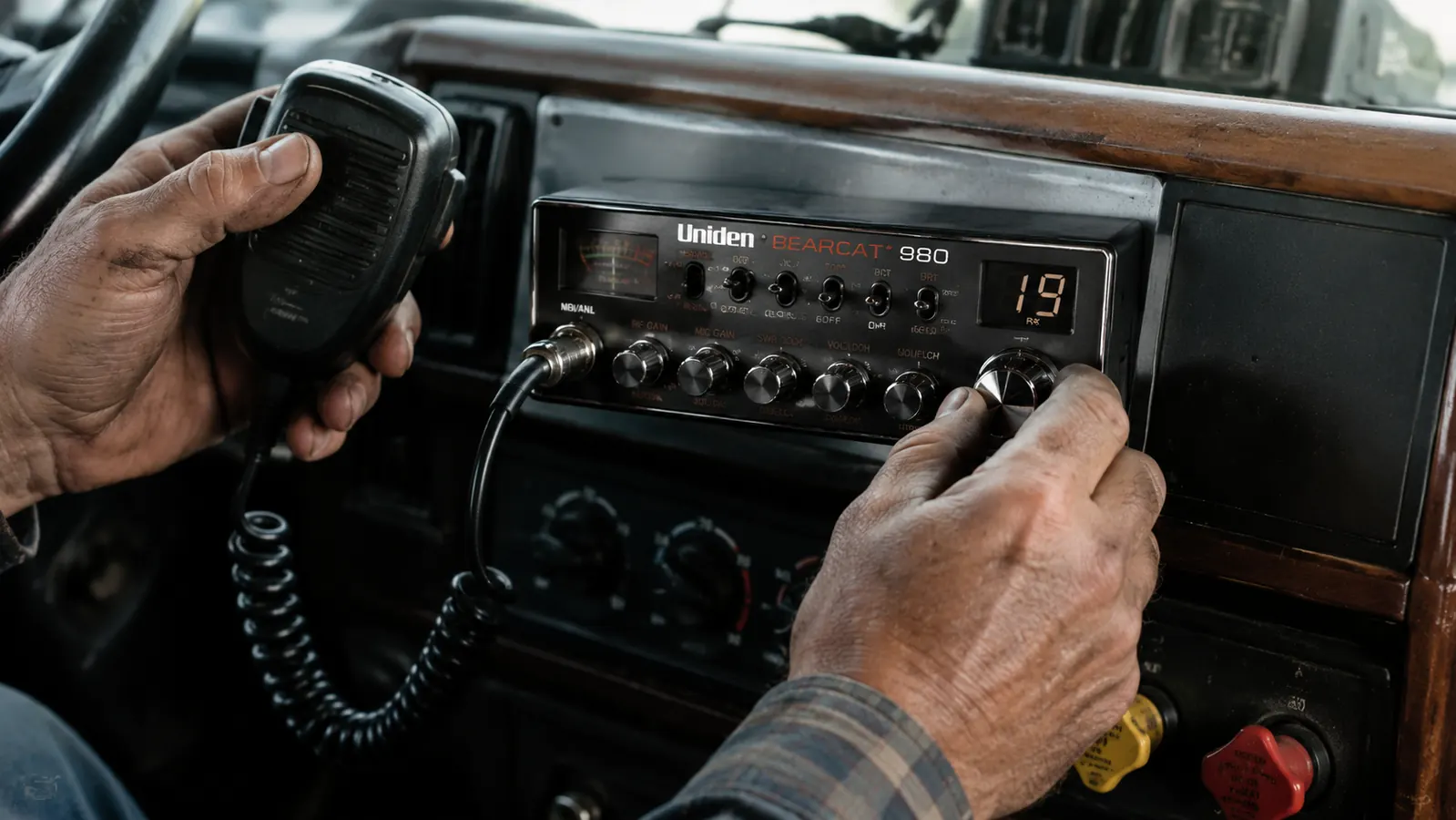
I put the Uniden BEARCAT 980 on my dash in the spring of 2024, running a 2019 Peterbilt 579 out of a terminal in Columbus, Ohio. Mostly Midwest runs, some Southeast, the occasional haul up into Michigan or down through Tennessee. Before it I had three different radios in six years: two no-name units from truck stop endcaps and one mid-range Cobra that started cutting out during highway skip. None of them lasted. The BEARCAT 980 has been on for two years without a single issue worth mentioning, which is about the highest praise I know how to give a piece of gear.
I am going to tell you what I actually like about it, what I do not love, and what kind of driver it makes sense for. If you are still running AM-only and wondering whether the SSB sideband is worth the extra money, I will give you a real answer on that too, not a spec-sheet summary.
The Quick Verdict
The best CB radio I have owned for OTR use. SSB sideband alone justifies the price over a standard AM unit if you run interstates year-round.
Amazon Check Today's Price →Two years on my dash and still going. Check today's price on Amazon.
The BEARCAT 980 is the SSB CB radio most OTR drivers land on after burning through cheaper units. It has 40 AM channels plus USB and LSB sideband, NOAA weather scan, a 7-color backlit display, and a talkback speaker that actually works in a moving cab. Worth checking current pricing before you buy a replacement radio you will regret.
Amazon Check Today's Price on Amazon →How I Have Used It
The 980 has been mounted on the same dash bracket since day one, wired into a fused tap on the ignition circuit. I paired it with a Wilson 1000 mag-mount antenna on the roof, tuned to around 1.2 SWR on the first try, which is about as clean as you are going to get without a shop-installed setup. I run AM on channel 19 the majority of the time for traffic and road condition chatter, same as everyone else. I switch to SSB, specifically USB, when I want to reach out past 20 or 25 miles, usually to catch weather reports ahead of a weather system, or when I know a run is going to be heavy on skip.
I drive roughly 120,000 miles a year. In two years on this radio, I have run through rain, summer heat in the Ohio Valley where the cab sits at 110 degrees when parked, cold starts in Michigan in January, and a stretch of I-70 through Kansas in a thunderstorm that killed every other driver's radio signal on the channel. The 980 kept running clean through all of it. I have not had to reset it, reflash it, or take it back off the bracket for any reason.
SSB vs AM: What It Actually Means Out Here
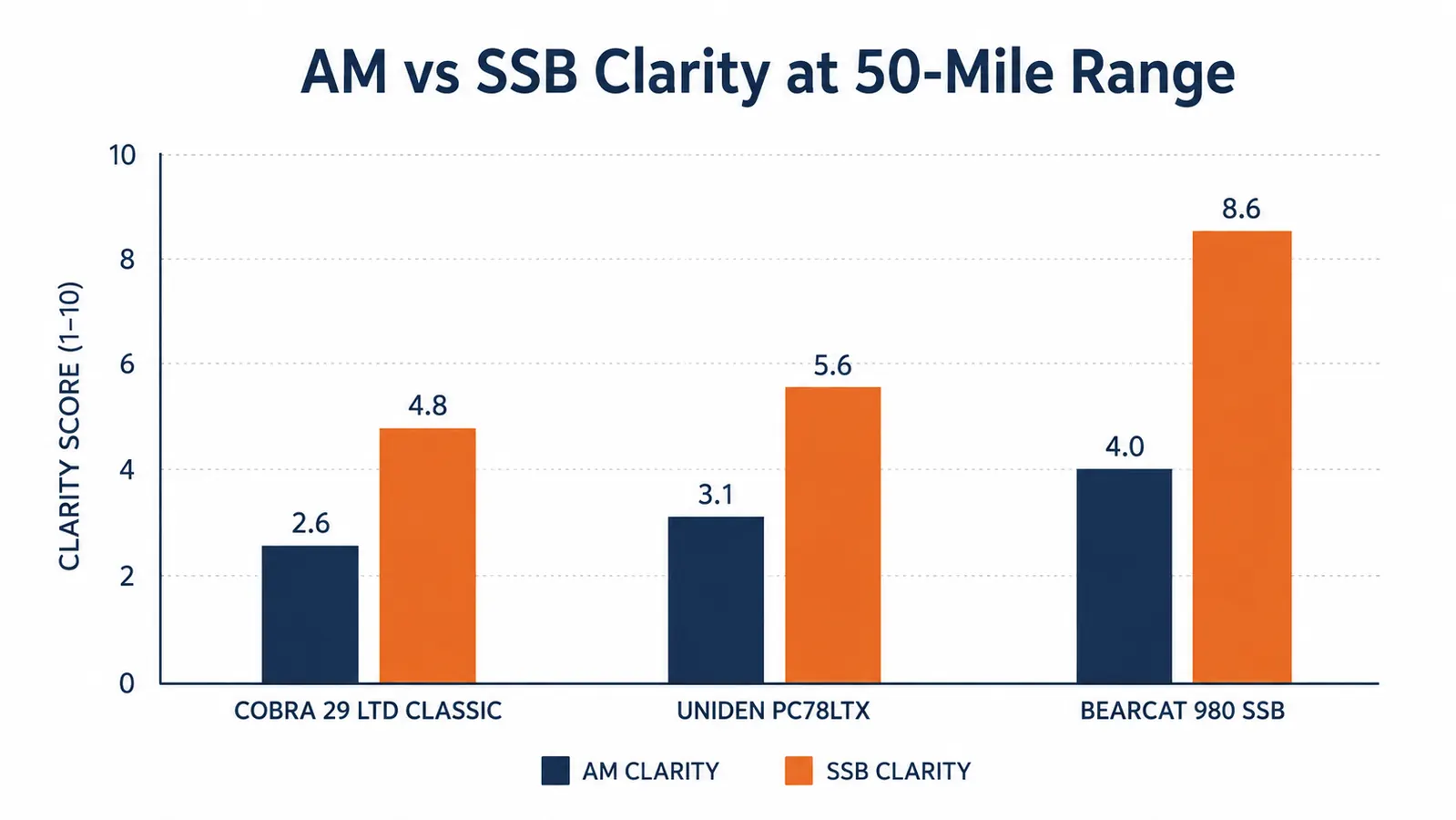
Single-sideband is the thing that separates this radio from a standard $60 CB, and it is worth understanding before you spend the money. Standard CB is AM, amplitude modulation. AM works fine for short-range communication, say, under 15 miles in decent conditions. But AM is also wide, noisy, and prone to skip, which is when signals bounce off the ionosphere and you start hearing truckers from 800 miles away clogging up channel 19. Skip is worse in spring and fall, and it can make channel 19 completely unusable for stretches at a time.
SSB, which stands for single-sideband, strips out the carrier wave and one of the two sidebands that AM uses. What you get is a signal that uses less of the radio spectrum and delivers more of your transmit power directly to the voice. In practical terms, it punches further and cuts through interference that would bury an AM signal. On USB, upper sideband, I can hold a clean conversation at 40 to 50 miles with another driver running SSB, and the signal is sharper and less fatiguing to listen to. LSB, lower sideband, is less common among truckers but useful for specific channel 38 LSB contacts if you want to reach out further.
The tradeoff is that both ends of the conversation need to be on SSB. You cannot talk SSB to a driver with an AM-only radio. So if you are in a convoy with mixed gear or you want to run channel 19, you are still on AM. The 980 handles both without any drama. Flipping between AM and SSB is one button press, and the radio remembers your last SSB channel when you switch back.
NOAA Weather Scan: The Feature I Actually Use Daily
I will be honest, I bought the 980 primarily for the SSB. The weather scan turned out to be the feature I use more consistently on a daily basis. The radio has a Weather button that immediately steps through all NOAA weather channels and locks onto the strongest signal. One press, and inside about three seconds you are hearing the nearest weather broadcast. There is also a Weather Alert mode that monitors in the background and fires an alarm if NOAA issues a severe weather alert for your area.
I had the weather alert trip twice in the past year. Once on I-64 in southern Illinois when a tornado warning went up, and once on I-75 in Kentucky during a flash flood advisory. Both times I had about 15 to 20 minutes of advance notice that gave me time to reroute or find a safe place to stage. Whether that saved me from anything serious I cannot say, but I would rather have the warning than not.
Sound Quality, Talkback, and the Noise Filter
Receive audio on the 980 is better than any other CB I have used. The internal speaker is clear enough that I do not feel like I am deciphering every transmission through a paper cup. The 7-color backlit display is readable in full daylight and does not wash out at night. I keep it on red, which is easy on the eyes during a night run without blowing out your night vision.
Talkback is a feature that plays your own transmitted audio back through the speaker so you can hear how you sound. Useful for adjusting your mic position and speak-distance. On a lot of cheaper radios the talkback is so quiet it is basically useless. On the 980 it is actually loud enough to hear while rolling at highway speed with the fan running. I used it for the first week to dial in my mic position, then left it off since I had what I needed.
The radio has a noise blanker and an automatic noise limiter built in. In my experience the noise blanker works well on electrical noise from the truck itself, the kind of 60-cycle buzz you sometimes get from a poorly grounded radio install. The automatic noise limiter helps in heavy skip conditions. Neither setting is magic, but both help, and you can run them together without one canceling out the other.
Before the BEARCAT 980, I replaced a CB every 18 months. Two years in and this one has not given me a single reason to look at anything else.
Mounting and Wiring in a Class 8 Cab
The 980 is a standard-size CB chassis, so any existing CB mount bracket will fit it. I used a metal overhead mount on my Peterbilt that puts the radio up and to the right of the steering column where I can reach the face without stretching. The coil cord mic is long enough to reach from that position without pulling. The radio is not light, so make sure your mount is solid. A loose-mounted radio vibrating at highway speed will stress the coax connection over time.
For wiring, I ran a dedicated fused line from the fuse block with a 5-amp fuse. The 980 draws about 1.5 to 2 amps receive and up to 4 amps on transmit at full power, so a 5-amp fuse gives you headroom without risking anything. Do not wire it through a switched accessory tap that cuts power when the truck is off, unless you want to re-squelch every time you start. I wire mine to always-on so it is ready when I get in. If you want step-by-step mounting guidance, see our guide on how to set up a CB radio in a semi truck.
The antenna pairing matters more than most people think. I have seen drivers with a $200 radio and a $15 magnetic antenna wondering why their range is poor. I would rather have a $100 radio and a properly tuned Wilson 1000 or Firestik 4-foot than the other way around. The 980 has a built-in SWR meter, which means you can tune your antenna without a separate meter. That alone is worth something if you do your own installs.

Alternatives I Considered
The Cobra 29 LTD is the radio most people compare this to, and I ran one for about 14 months before it started having squelch issues. The Cobra is an AM-only unit, so it has no SSB. It is a solid radio for close-range CB use and it costs less, but if you want SSB it is simply not in the conversation. The comparison between these two comes down to whether you need sideband or not. If you are a regional driver doing 200-mile days and rarely need to punch out past 20 miles, the Cobra 29 LTD is a reasonable option at a lower price. If you are running I-80 coast to coast or spending long stretches on the interstates, the SSB on the BEARCAT 980 pays for itself in usefulness. For a full head-to-head breakdown, see our comparison of the Uniden BEARCAT 980 vs Cobra 29 LTD.
The President McKinley II is the other radio that comes up in SSB conversations. It has slightly higher output power on SSB and a more refined audio stage. It also costs roughly 30 percent more and has a learning curve on the menu system that took me a couple of days to work through on a demo unit. For most OTR drivers, the 980 hits the right balance of features and usability. The McKinley is worth considering if you are a serious DXer or you want to squeeze every decibel out of sideband, but that is a different use case than everyday trucking.
What I Liked
- SSB sideband on both USB and LSB gives you genuine range advantage over AM-only radios
- NOAA weather scan with background alert mode is legitimately useful, not just a checkbox feature
- Built-in SWR meter saves you the cost of a separate meter for antenna tuning
- 7-color display is readable in full sun and easy on the eyes at night on a red setting
- Talkback is loud enough to actually use in a moving cab
- Two years of daily use with zero reliability issues
Where It Falls Short
- SSB is only useful if the driver you are talking to also has an SSB-capable radio
- At today's price it costs roughly three times a basic AM CB, which is a real consideration for lease operators on tight margins
- The face buttons are small and close together, harder to work without looking in low light until you learn the layout
- Mic audio quality is average stock; some drivers swap to an aftermarket mic for better transmit clarity
Who This Is For
The BEARCAT 980 makes the most sense for OTR drivers who spend the majority of their miles on interstates, especially north-south runs where skip conditions are more severe, or long east-west corridors where you want weather information well ahead of your position. It also makes sense for owner-operators who plan to keep the same rig for several years and want a radio they will not have to replace. If you are tired of buying $60 radios every year and a half, the math on a durable unit works out in your favor over a 3-to-5 year horizon.
Who Should Skip It
If you are a regional driver doing short-haul runs where CB use is minimal, a basic AM unit does the job at a third of the cost. If the drivers you regularly run with or convoy with are all on AM-only radios, the SSB feature is mostly wasted since you will spend all your time on AM channel 19 anyway. The 980 is also probably more radio than you need if you mostly use CB for road condition chatter in a 50-mile radius. There is no shame in a simpler setup if simpler is what you actually need.
If you are ready to stop replacing CB radios every couple of years, this is the one to buy.
The Uniden BEARCAT 980 has 40 AM channels, USB and LSB sideband, NOAA weather scan with background alerting, a built-in SWR meter, and a 7-color backlit display. It is rated 4.4 stars across more than 3,000 reviews. Check today's price on Amazon and see if it fits your budget before your next run.
Amazon Check Today's Price on Amazon →