

I've been running CB radios in trucks since before some of these reviewers had their CDLs. Uniden gear, Cobra gear, a couple of Radio Shack units I'd rather forget. When the BEARCAT 980 SSB came out it had the CB world pretty excited because SSB sideband on a stock-looking radio at that price point was genuinely new. I bought mine about three years ago for my Freightliner Cascadia, and I've put a lot of miles on it since. Thirty states, four load boards, more channel-19 chatter than I can count.
Here's what I want to tell you before you read the rest of this: the BEARCAT 980 is a good radio. I still run it. But the reviews that handed it five stars and called it a day skipped four things that matter, and if you go in blind on any one of them you're going to be frustrated in the first week. So this is the honest version.
The Quick Verdict
Genuinely solid SSB CB radio, but your antenna does 80% of the work and the mic cord is the weakest part of the package.
Amazon Check Today's Price →If your antenna is already tuned and you want the best SSB CB available under $200, the BEARCAT 980 is the right call.
Uniden BEARCAT 980 SSB, 40-channel, NOAA weather scan, 7-color backlit display. Check current pricing before you buy a cheaper radio and regret it in six months.
Amazon Check Today's Price on Amazon →How I've Used It: Three Years, 30 States, One Big Lesson About Antennas
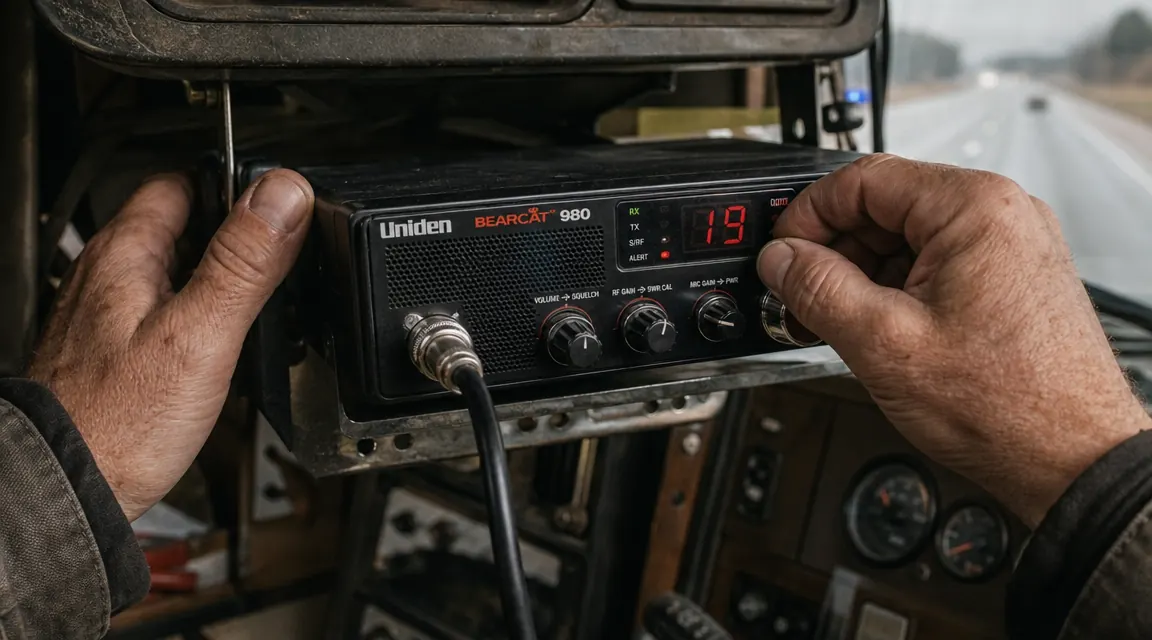
I run flatbed mostly, I-40 corridor with occasional swings up through I-80. I mounted the 980 on a factory bracket in the Cascadia's overhead console, ran Wilson coax through the A-pillar down to a Firestik 4-footer on a driver-side mirror mount. My SWR came in at 1.4 on that setup. That matters a lot, and I'll get into why in a minute.
Day to day: the audio is noticeably cleaner than the Cobra 29 I ran before it. On AM it pulls in weak signals better than the Cobra did. On SSB upper sideband, which is where most serious long-range truck-to-truck traffic runs when it runs at all, I've had conversations across 50 miles of flat Kansas interstate that would have been static on AM. The weather scan is real and useful. I've caught severe weather alerts while crossing Oklahoma that came through before the weather app on my phone updated. I use that feature. I'm not padding the review.
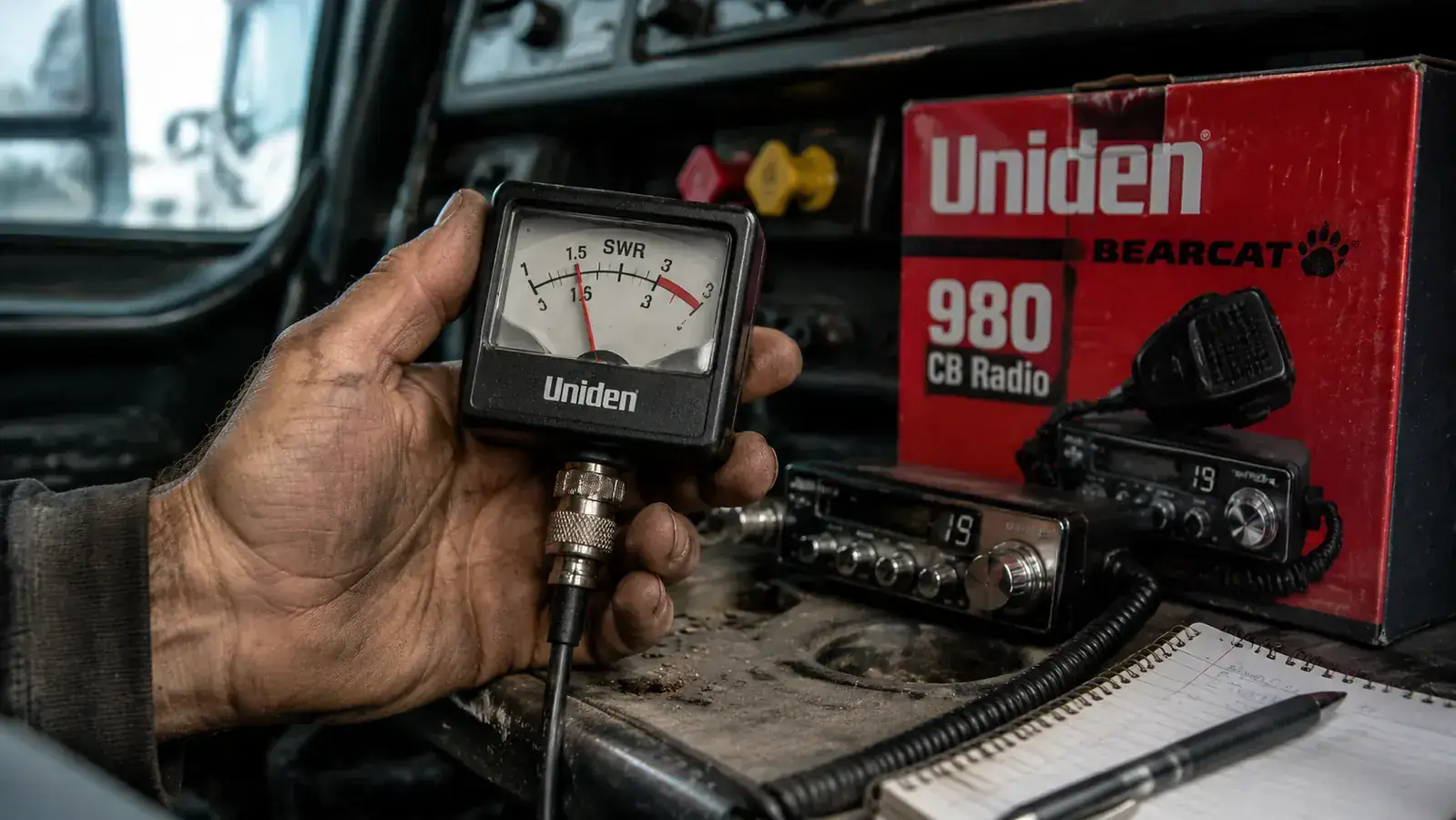
But here's the thing nobody put in their five-star review: I did all of that with a properly tuned antenna. My buddy Dale bought the same radio last spring, plugged it into the magnetic-mount no-name antenna he'd been running on his Cobra, and called me a week later saying the 980 was garbage. His SWR was pushing 2.8. At 2.8 you're cooking the finals on your radio and you're getting maybe 30% of the power out through the antenna. The radio wasn't garbage. His installation was garbage.
The Antenna Is Doing 80% of the Work. Stop Blaming the Radio.
I can't say this plainly enough: a BEARCAT 980 on a bad antenna will sound worse than a $60 Midland on a properly tuned antenna. Every CB radio on the market operates at the same legal limit of 4 watts AM. SSB gets you a little more effective power through improved signal focus, but the antenna system is the single biggest variable in your station. Length, mount position, coax quality, ground plane quality, and SWR all matter more than the radio itself.
SWR, standing wave ratio, tells you how efficiently your antenna is radiating power. Under 1.5 is good. Under 2.0 is acceptable. Over 2.5 and you're wasting power and slowly damaging your radio. The 980 has a built-in SWR meter, which is a genuine feature, but it only tells you the number. Fixing a bad SWR reading requires a tunable antenna and some patience. If you've never tuned a CB antenna before, read the how-to guide on this site before you buy anything. An untuned antenna is a partial refund waiting to happen.
For the truck setup I'd recommend: a 4-foot Firestik or K40 on a good no-ground-plane NMO mount or a sturdy mirror mount with a quality coil spring to absorb vibration. Run Wilson 400 coax, not the generic stuff. Yes that costs more. No, you don't want to skip it.
SSB Sideband: Incredible When It's Active, Quiet When It's Not
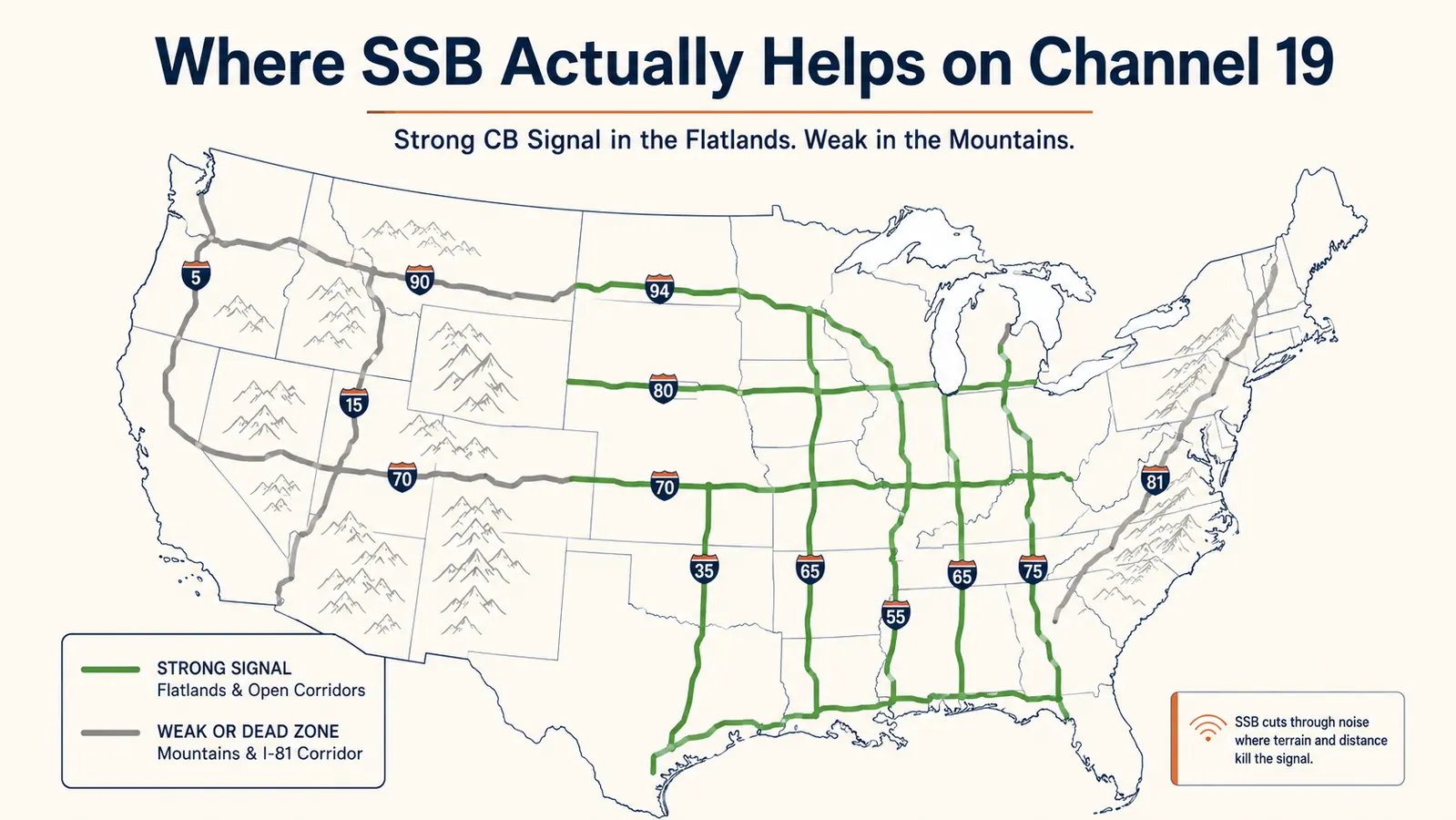
SSB is the reason you pay extra for the 980 over a basic 40-channel AM-only unit. Upper sideband on channel 38 is where serious CB operators run long-distance skip, and when propagation is right in the spring and fall it is genuinely impressive. I've talked to a driver in Tennessee from a rest area in Arizona. That's not made up.
Here's the honest part: on most days, on most lanes you run, SSB is quiet. The I-15 through Nevada, the I-5 corridor in California, I-81 through Virginia, most of the northeast, a lot of the northwest mountain runs. SSB on those corridors on an average Tuesday in February is a dead band. The professional driver community using sideband is smaller than it was, and it tends to cluster on specific routes and specific times of day. If you run the midwest flatland interstates, especially I-80 and I-70, you'll find SSB active more often. If you run regional short-haul or northeast corridors, SSB is mostly going to be a radio feature you paid for and rarely use.
I'm not saying that to talk you out of it. I'm saying it so you go in with accurate expectations. The SSB is not a disappointment if you know where the traffic is. It IS a disappointment if you expected to flip to sideband and find a busy channel wherever you drive.
A BEARCAT 980 on a bad antenna sounds worse than a $60 Midland on a tuned one. Every CB runs the same 4 watts. The antenna is the whole game.
The Noise Gate Threshold: Real Feature, Needs Adjustment, Nobody Tells You This
The 980 has a noise-canceling mic and what Uniden calls a noise gate. It's designed to cut out background engine noise and road noise so the person on the other end hears your voice clearly. In theory that's great. In practice, if you run a loud motor, like a pre-emission Cat or an older Cummins that idles rough, or if you're running with a bunk heater going, the noise gate threshold needs to be dialed in or it will cut the beginning of your transmission every single time.
What happens: you key up and start talking, and the first syllable or first word gets clipped before the noise gate opens. To other drivers it sounds like you're cutting out or your mic is failing. It took me about two weeks of fiddling with the mic gain setting to get it consistent in my rig. Softer mic gain opens the gate more easily but also picks up more road noise. Harder mic gain sounds cleaner on background noise but clips more on fast speech. The sweet spot for my Cascadia is a mic gain of 7 out of 10 with the factory mic 2 to 3 inches from my mouth. Your rig will probably be different.
This isn't a dealbreaker, but it's the kind of thing that makes drivers return a perfectly fine radio because they think it's broken when it's actually just needing a half-hour of setup time. Spend 20 minutes keying up and talking to yourself in a parking lot before you head out on a load. Adjust mic gain. Get it dialed.
The Mic Curl Cord: My Biggest Gripe with This Radio
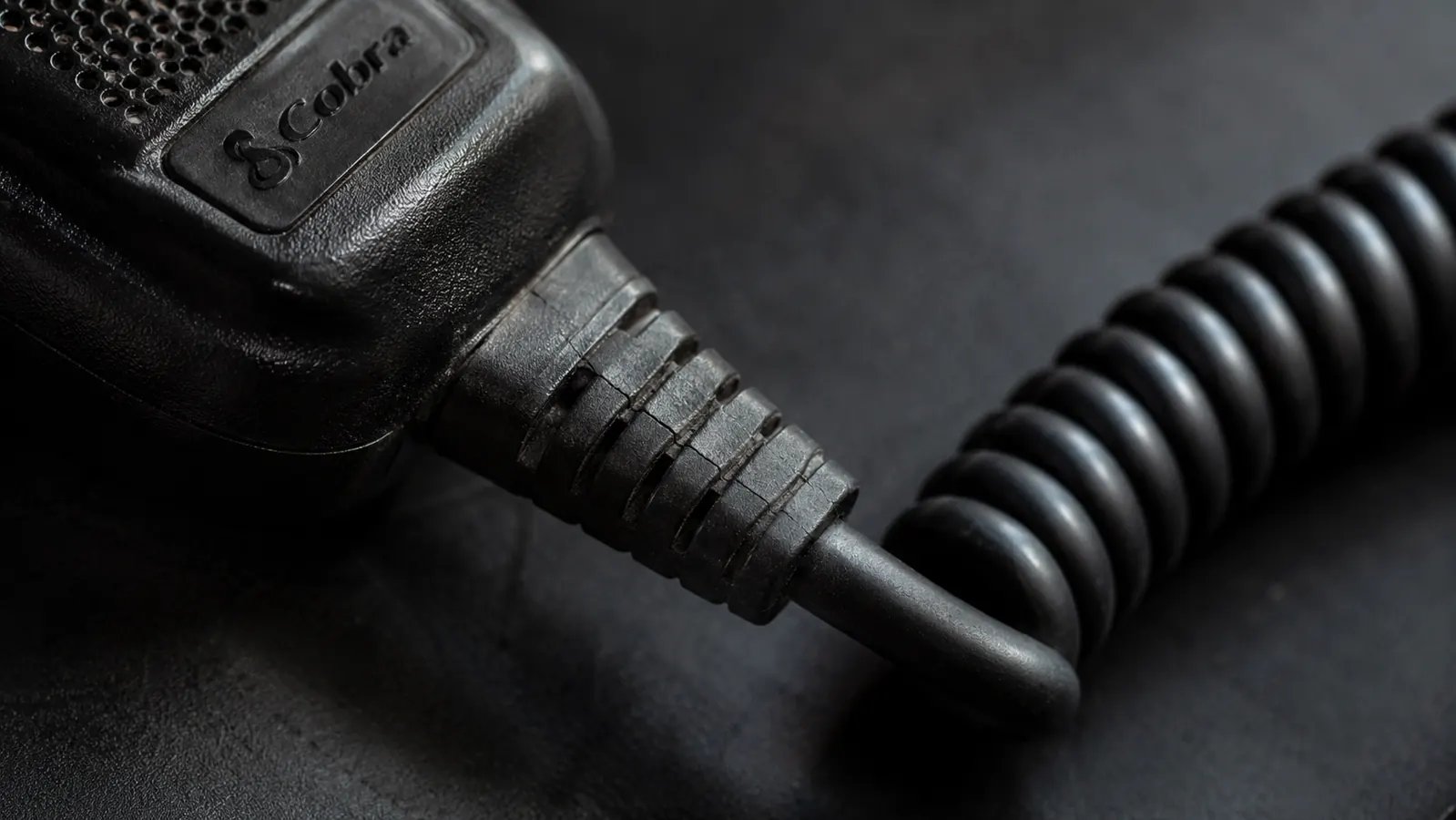
The BEARCAT 980 ships with a noise-canceling mic that feels solid in the hand and has a good PTT button. The weak link is the coiled cord where it plugs into the mic body. That strain relief collar at the base of the mic is where the cord starts to crack in cold weather after about a year of daily use. I've seen two of these go, mine and Dale's, both at that same spot. It doesn't fail catastrophically. What happens is you start getting intermittent static or drop-outs when the cord flexes, usually right after a cold start in winter when the rubber is stiff.
The fix is cheap. A CB aftermarket mic runs $20 to $35. I replaced mine with a RoadKing RK56B and the problem went away. But you should know going in that the factory mic cord has a defined weak point and you'll likely replace it inside two years if you're keying up multiple times a day.
Some guys wrap the strain relief collar in self-amalgamating tape to reinforce it before it fails. That buys extra time. I'd rather just swap the mic early and not deal with it.
What I Liked
- SSB sideband is genuinely useful on the right corridors, especially midwest interstates in spring and fall propagation season
- Audio clarity on AM is noticeably cleaner than competing radios at this price point
- NOAA weather scan works and has caught severe weather before the apps did
- 7-color backlit display is readable in full sun and at night without adjustment
- Built-in SWR meter removes one step from antenna tuning
- RF gain and squelch controls are separate physical knobs, not buried in menus
- Solid build quality on the radio chassis itself, no rattle or flex
Where It Falls Short
- Mic coiled cord strain relief fails at the mic body after 12 to 18 months of daily keying in cold climates, plan to replace the mic
- Noise gate threshold requires real tuning time for loud or rough-running motors
- SSB is a dead band on many regional and northeast corridors, you pay for a feature you may rarely use
- Radio performance is completely antenna-dependent, bad SWR kills it and most reviews don't mention this
- Firmware update process is awkward and requires a USB-B cable most drivers don't have on hand
The Firmware Quirk That Trips People Up
The BEARCAT 980 has a firmware update process that Uniden documents on their website. I mention it because it's one of those things that looks technical but really isn't, and drivers occasionally see odd display behavior or button response issues that a firmware update fixes. The catch is that the update requires a USB-B cable, the older square-plug type, which almost nobody carries anymore. If you buy one of these radios and it behaves strangely on the button inputs, before you return it, check the Uniden site for a firmware update and grab a USB-B cable from a dollar store or truck stop electronics rack.
I updated mine once about 18 months into ownership. Fixed a minor issue where the weather scan would occasionally lock on a weak station and not cycle forward. After the update it was fine. Not a crisis, just a thing to know about.
Who This Is For
You run OTR, especially midwest or southern interstates where CB channel 19 is still active and where there are real SSB users in your region. You've already got a decent antenna setup or you're willing to invest in one. You understand that a CB radio is a communication system, not a plug-and-play device, and you're prepared to spend a couple hours getting the antenna tuned and the mic gain dialed. You want the best AM audio quality available on a non-modified stock CB combined with real SSB capability. That's the BEARCAT 980 buyer.
Who Should Skip It
You run regional short-haul in the northeast or northwest where CB traffic is sparse and SSB use is nearly nonexistent. You're not willing to tune an antenna or spend the setup time. You just want something that plugs in and works for basic channel-19 monitoring. In that case a Cobra 19 Mini or a basic Midland 75-822 will cost you half the money and do the job fine. The 980's advantages are real but they require the right setup to matter. If you want the deeper comparison on BEARCAT versus Cobra for OTR, I wrote that up separately at the link below.
Your antenna is tuned, your squelch is set, and you're ready for a radio that keeps up with the miles.
The Uniden BEARCAT 980 SSB is the most capable stock CB radio available at this price. 40 channels, SSB sideband, NOAA weather scan, and a display you can actually read at 3 AM through a Georgia rain squall. Check today's price before it moves.
Amazon Check Today's Price on Amazon →