

Let me tell you something about Amazon reviews that took me three bad cushion purchases to figure out. A guy buys a seat cushion on a Monday. It feels great for two weeks. He leaves a five-star review on day 10. He doesn't know yet that the foam will be half its original height by month two. That's not a conspiracy. It's just how review timing works, and it's exactly why you can't trust the star rating alone on something you're going to sit on for 600 miles a day.
I'm Stuart. I've been pulling OTR for going on 27 years. I drive a Freightliner Cascadia right now, and before that I ran a Kenworth T680 for eight years. I've tried eight different seat cushions in that time, ranging from a $12 gel disc from a truck stop to a $189 orthopedic thing a chiropractor sold me. The TushGuard, ASIN B0B5SW6381, currently sits at a 4.5-star average across almost 28,000 reviews. I bought it because I got tired of the cheap stuff going flat and I wasn't ready to spend $80 on a CushionLab. What I found was more complicated than the reviews suggest.
The Quick Verdict
Solid mid-range cushion that earns its rating IF you use it right. But the vinyl-seat sliding problem is real, the sizing runs smaller than you expect, and the foam compresses noticeably by week six. Know what you're buying.
Amazon Check Today's Price →Your back doesn't care how many stars a cushion has. It cares how the foam feels at hour nine.
The TushGuard runs under $25 and has real coccyx relief and memory foam density that outperforms the gel discs at truck stops. Check today's price on Amazon before it moves.
Amazon Check Today's Price on Amazon →What the Five-Star Reviews Skip
I've read through a few hundred of these reviews because I was genuinely trying to figure out if my experience was typical. The pattern is clear. The five-star reviews are almost all written within the first 30 days. The two-star and three-star reviews? Almost all of them mention something about 30 to 90 days in. That gap in time tells you something.
What they don't tell you: this cushion slides on vinyl seats. I've got standard vinyl cab upholstery in my Cascadia. The TushGuard has a non-slip bottom, and it does work, up to a point. On smooth pavement it stays put. On I-80 through Wyoming in February, after about an hour of vibration and minor weight shifts, it creeps forward. By mile 200 it had moved a couple inches forward and I had to reach down and yank it back. That is not a deal-breaker, but it is a real thing that nobody in the top reviews mentions because they probably tested it at a desk or in a car on short commutes.
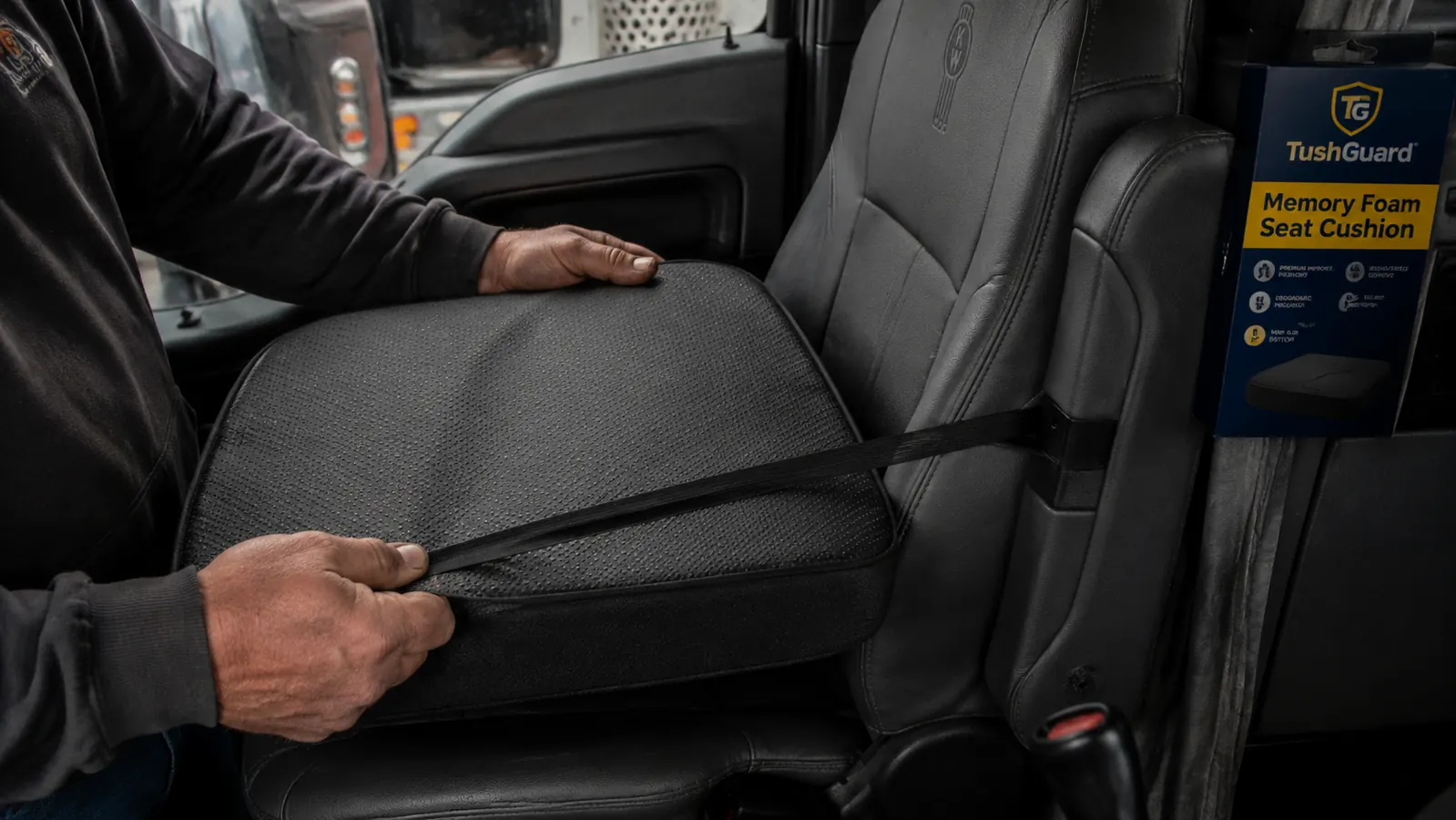
The fix, which I figured out after two weeks of annoyance, is to use the included elastic strap. That strap loops around the back of the seat. When I first got the cushion I skipped it because it looked like it would be a pain to deal with every time I get in and out. It turns out it takes about four seconds and it completely solves the sliding problem. The reviews that complain about sliding almost always say they didn't bother with the strap. Use the strap. Problem solved.
The Honest Foam Compression Timeline
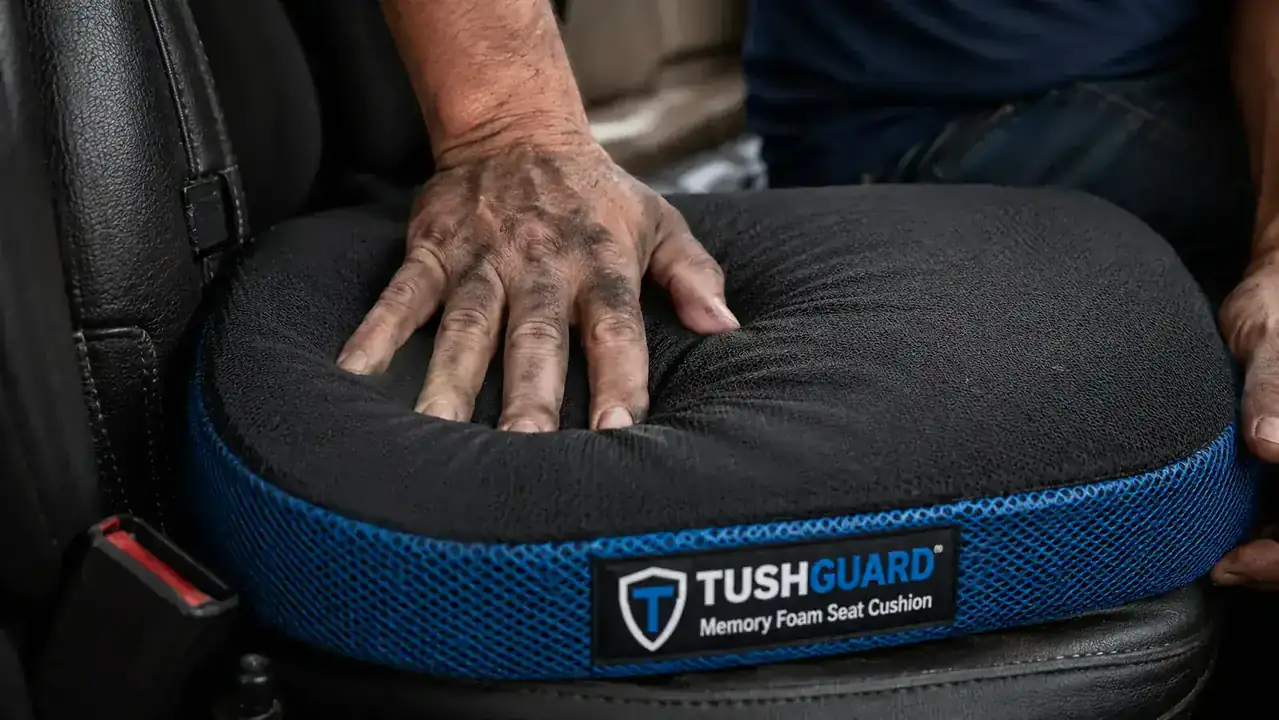
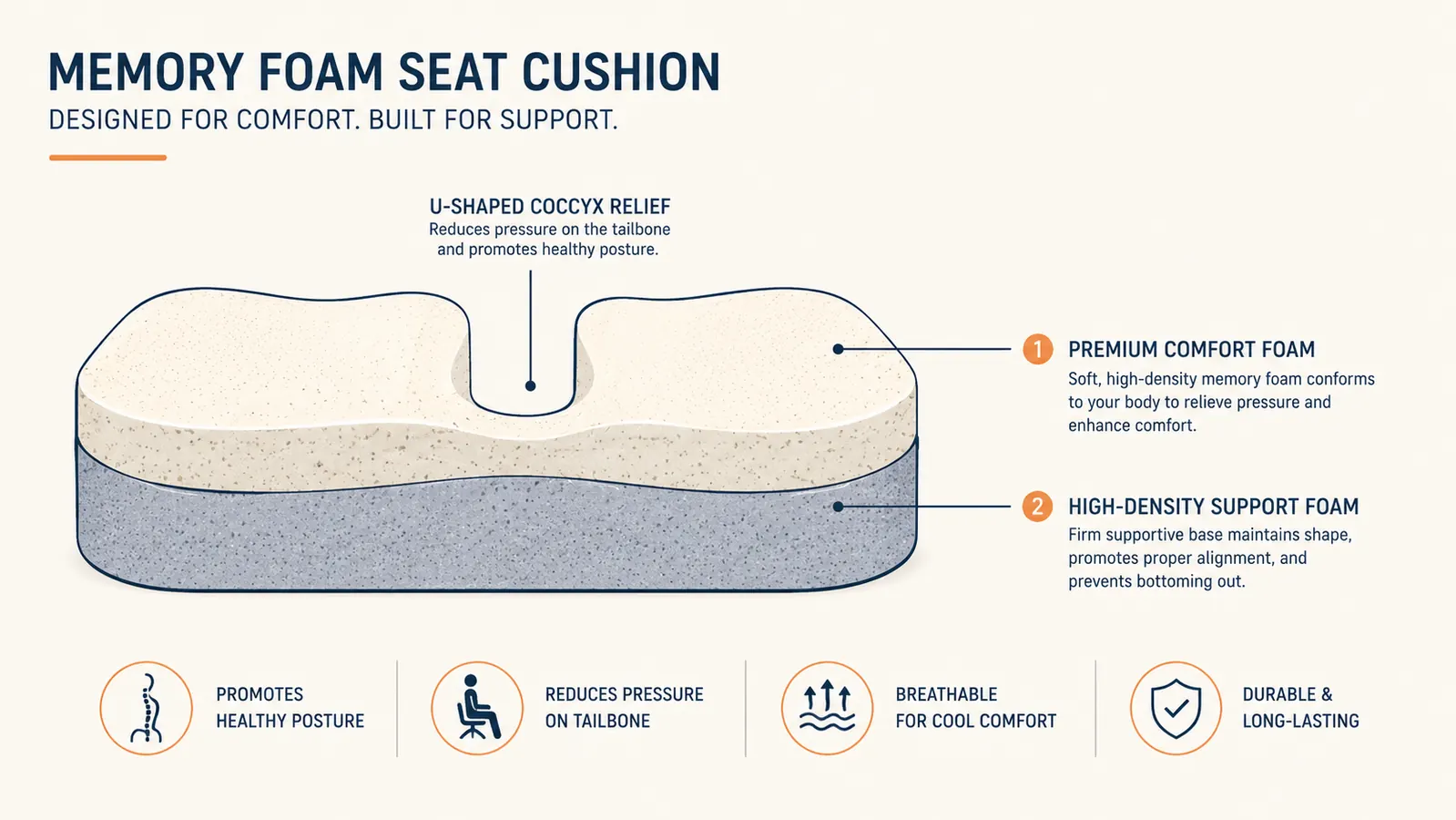
The TushGuard uses what they call high-density memory foam. On the scale of truck-driver-hours, here is roughly what I noticed over time. Week one and two: it feels genuinely thick. I am 6 foot 1 and 215 pounds. The cushion felt plush in those first sessions. It was noticeably better than the gel disc I had been using. My tailbone pain, which had been a daily nuisance, went away almost immediately because of the cutout in the center. That U-shaped coccyx channel is real and it works.
By week five or six, the foam had compressed. Not flat. Not ruined. But it felt meaningfully thinner under my sit bones than it did on day one. I pressed on it with my hand and compared it to a photo I had taken of the original height. There was a visible difference. This is normal for memory foam under daily pressure. What matters is whether it still provides relief at the compressed height, and the answer is mostly yes for me. But if you are heavier than 220 pounds or you are sitting on it for longer than eight hours at a stretch, you should go in knowing the foam will soften over time.
The coccyx cutout is not marketing fluff. It is the only reason this cushion actually fixes tailbone pain. The foam density is adequate. The compression over time is the one honest conversation nobody is having about this product.
Sizing: It Runs Smaller Than You Think
The TushGuard measures about 18 inches wide by 14 inches deep. My Cascadia seat is wider than that. There is a gap of a few inches on each side of the cushion, which means my thighs rest partly on the bare seat upholstery and partly on the cushion edge. This is not painful. But if you are wide through the hips or you have gotten used to a full-width seat cover or cushion, this will feel narrow. A driver with a 40-inch waist is not going to be happy about this sizing.
The depth at 14 inches is also shorter than some seat bottoms. On my Cascadia, there is about an inch of seat exposed at the front. Again, not a problem in practice. But if you sit with your thighs fully extended on the seat bottom, the support cuts off a little early. For me, 6 feet 1, it was fine. For someone taller with longer femurs, it might not be.
How It Compares to What You Already Have
Most drivers I talk to are choosing between three options. The truck-stop gel disc, usually $15 to $20, that goes completely flat in six weeks. The OEM seat foam in your truck, which was designed by people who have never driven more than 200 miles at a stretch and which provides essentially zero lumbar separation or tailbone relief. And then the TushGuard, sitting in that middle range. It is meaningfully better than the gel disc. It will last longer and the coccyx channel alone is worth the difference in price.
Where it falls short compared to the premium options, specifically the CushionLab Extraordinary and similar products in the $60 to $80 range, is foam density and long-term shape retention. I have used a CushionLab. It holds its shape better through a long haul. If you are running 600-plus mile days regularly, the CushionLab is worth the price difference. If you are doing regional runs, 200 to 400 miles daily, or if your truck's OEM seat is already decent and you just need tailbone relief, the TushGuard at its current price is a genuinely smart buy. I can see why it has nearly 28,000 reviews.
The Cover: Wash It or Replace It
The cover is a mesh fabric that zips off and is machine washable. This is actually a bigger deal than it sounds. A cab seat cushion lives in a world of spilled coffee, road grime, food crumbs, and sweat. After two months in my Cascadia, the cover needed a wash. It came out of the washing machine in good shape. The zipper worked fine. The mesh fabric did not pill or warp. That is a legitimate quality point that the reviews do not highlight enough.
What I will say is that the cover is not particularly durable against sharp edges. The zipper pull started to show some wear after a few wash cycles. Not broken, just worn. And if you are someone who carries a multi-tool on your belt or has any sharp objects on the seat area, the mesh is not going to survive contact with them. That's just physics. Treat the cover like the consumable component and you will be fine.
What I Liked
- Coccyx cutout genuinely eliminates tailbone pressure on long hauls
- Memory foam density is a real step up from gel truck-stop discs
- Removable mesh cover is machine washable and holds up to repeat washing
- Elastic strap actually works when you use it, solves the sliding problem completely
- Under $25 at current price makes it easy to replace when foam fully compresses
- Nearly 28,000 reviews means sizing edge cases are well documented if you dig
Where It Falls Short
- Slides on vinyl seats without the strap, and most reviews skip this detail
- Foam compression is noticeable by week five or six under daily driving weight
- 18-inch width is narrow for larger drivers or wide truck seats
- Not the right tool for 600-mile days if you have serious back pathology
- Cover zipper shows wear after several wash cycles

Who This Is For
The TushGuard makes the most sense for regional or mid-range OTR drivers who are dealing with tailbone or coccyx pain and haven't tried a memory foam cushion yet. If you are currently using the truck-stop gel disc or nothing at all, this is a significant upgrade at a price point that won't make you think twice. It also makes sense as a second cushion to keep in a day cab or bobtail situation where the seats are worse than usual. Under $25 is not a big gamble.
It also works well for drivers who swap trucks. Company drivers, lease operators who don't own their rig, anyone who sits in a different seat week to week. The TushGuard is light, it rolls up acceptably, and you can throw it in a bag between assignments. That portability is worth something.
Who Should Skip It
If you are over 240 pounds and pulling 11-hour days, the foam compression timeline is going to frustrate you. The cushion will still work, but it will feel appreciably thinner than it did at purchase within four to six weeks. You would get more miles out of a denser foam product. Drivers with diagnosed lumbar disc issues or sciatica should also look harder at products built specifically around lumbar support rather than coccyx relief. The TushGuard helps the tailbone. It does not fix the lower back in the same way a properly positioned lumbar roll does. Those are different problems.
And if you already own a CushionLab or similar premium foam cushion and it is working for you, there is nothing here that will make you want to switch. The TushGuard is a value play, not a premium play. It knows what it is. I just wish the Amazon review ecosystem would tell you that up front instead of burying the long-term foam behavior under a thousand five-star posts from week one.
If your back is talking to you before you hit the state line, it is worth trying a $25 fix before the $800 chiropractor visit.
The TushGuard's coccyx cutout and memory foam base are the right combination for tailbone pain. Use the strap, wash the cover every month, and replace it when the foam compresses. At current price, that math works for most drivers.
Amazon Check Today's Price on Amazon →