

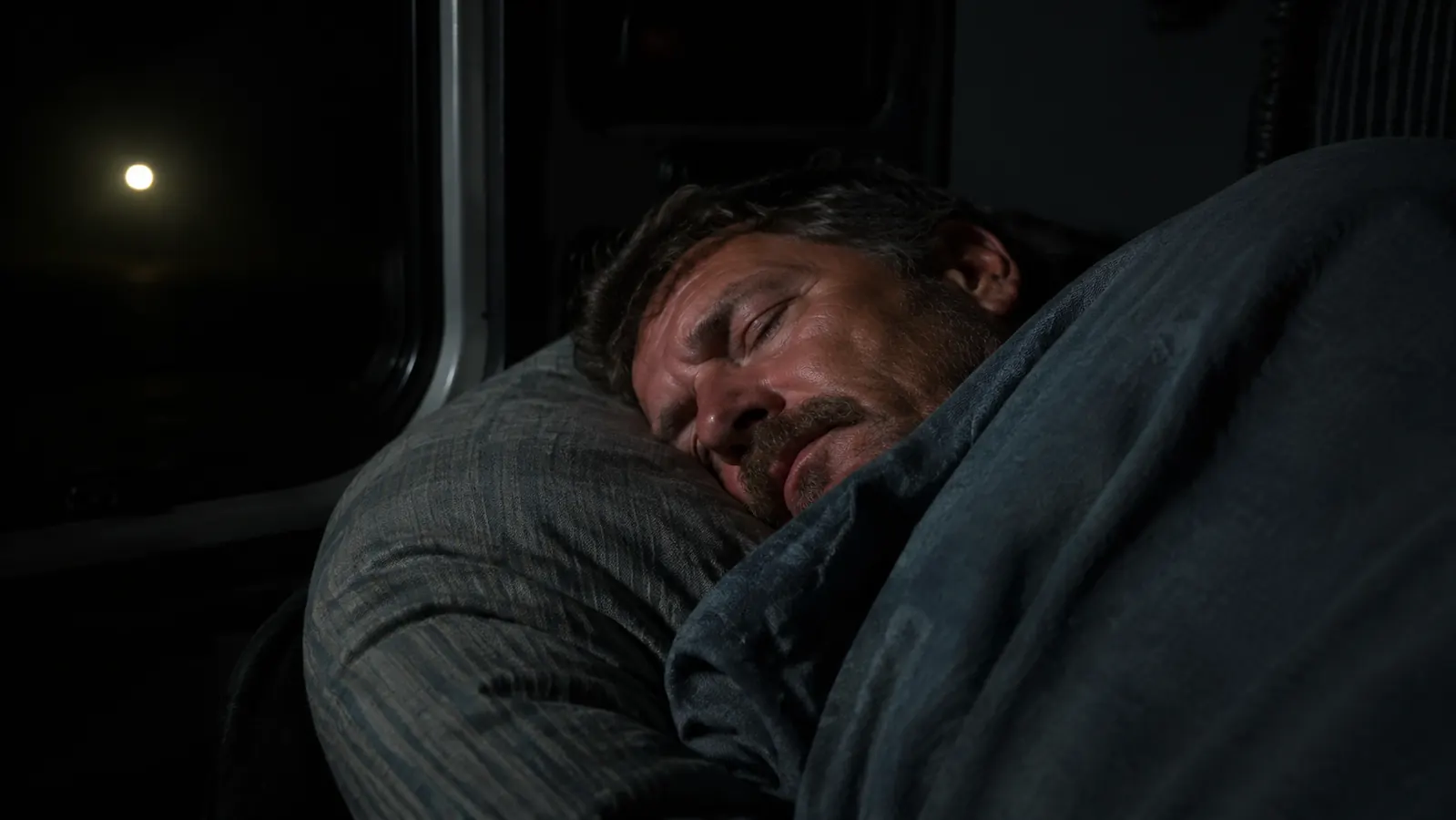
I ran nights for three years before the schedule finally flipped on me and I had to start sleeping days. First week was a disaster. I'd get parked at a Flying J by 10 AM, pull the factory curtains shut, and wake up two hours later sweating with light pouring in around every edge. The factory curtains in most sleeper cabs are decorative at best. They reduce glare a little. They do not block light for daytime sleeping in a semi sleeper. Not even close.
The problem isn't complicated, but it does have several parts. Light gets into a sleeper cab through more openings than most drivers think about until they're lying there at noon cursing the sun. This guide walks through every one of those entry points in order, explains what to do about each one, and tells you which fix matters most. I'll reference the NICETOWN Short Blackout Curtain panels throughout because that's what's worked in my Freightliner, but the approach applies to any rig.
If bright daytime light is stealing your sleep hours, the NICETOWN blackout panels are where I'd start.
They're specifically sized for RV bunks and sleeper cab windows, run under $25 for a two-pack, and they install with a tension rod in about ten minutes. Over 46,000 ratings on Amazon.
Amazon Check Today's Price on Amazon →Step 1: Take a Light Inventory Before You Buy Anything
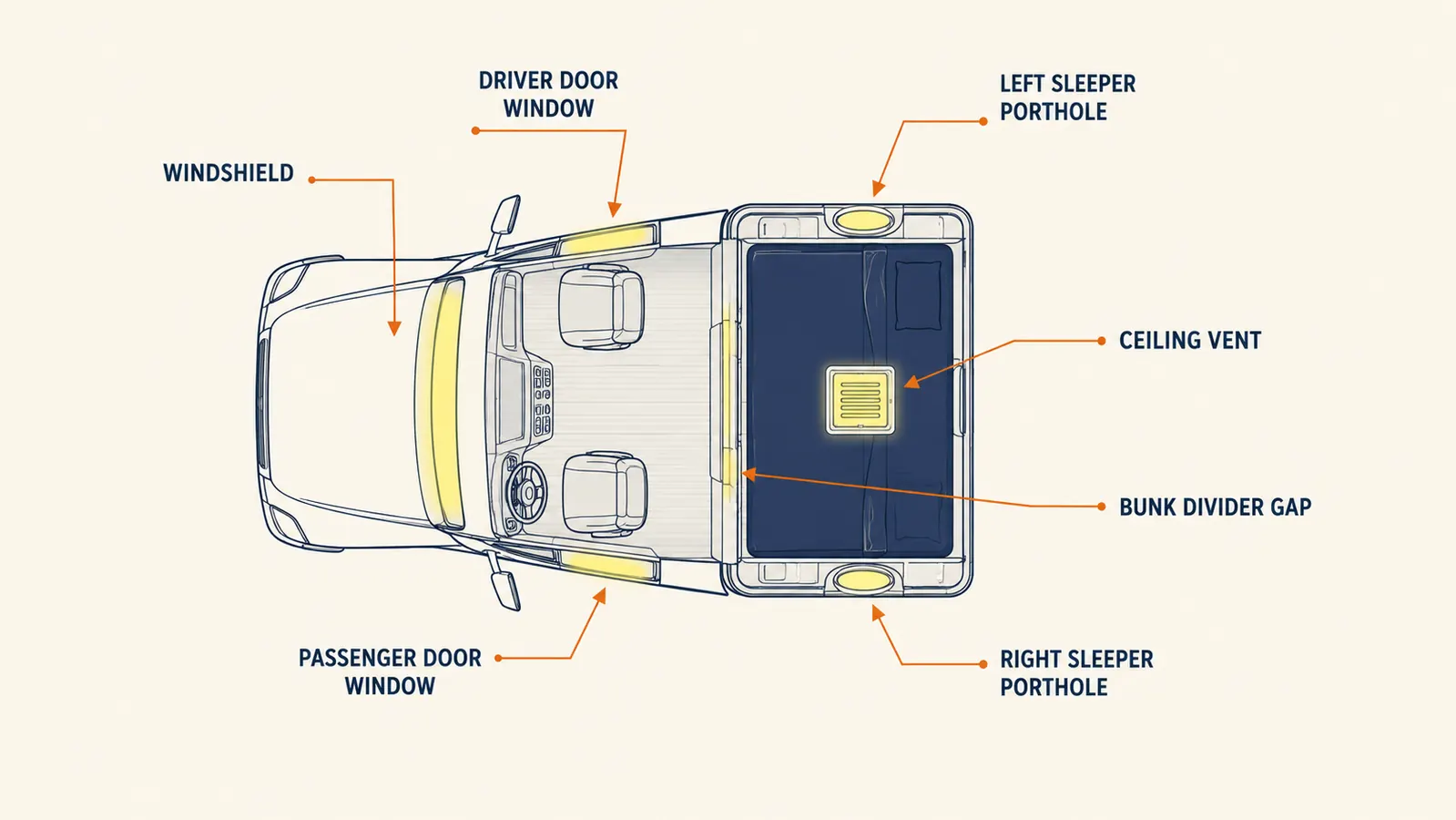
Park somewhere bright, a truck stop at 11 AM works, close every factory curtain you have, and sit in the back of the sleeper for five minutes. Let your eyes adjust. Now look for every crack, gap, and glow. Write them down or take a phone photo. Most drivers have at least five distinct light sources they've been ignoring.
The typical inventory on a mid-size sleeper: the windshield (huge open pane up front), the driver door window, the passenger door window, one or two porthole windows on the sleeper walls, and the gap along the top of whatever bunk divider curtain the factory installed. Some rigs also bleed light through the cab roof vent trim if the cover seal has dried out. Knowing what you're dealing with tells you exactly what to spend money on and in what order.
Do this step before ordering anything. I've seen drivers buy a windshield sunshade, decide it's good enough, and then wonder why they still can't sleep. It wasn't the windshield killing them, it was the two porthole windows they forgot about.
Step 2: Cover the Sleeper Porthole Windows First
The porthole windows on the sides of the sleeper berth are almost always the worst offenders for daytime sleeping, because they're right at bunk level. Morning sun comes in at a low angle and hits you directly in the face through those windows. The factory tint helps a little, but tint is not blackout. Tint is sunglasses. Blackout is a blindfold.
This is where the NICETOWN panels come in. The short version of these panels is designed for exactly this size window. Pick up a set of tension rods that fit the width of your porthole frames, hang the panels, and slide the rod into tension position. No drilling, no permanent mounting hardware, nothing that would bother a fleet or violate a lease agreement. The panels use a triple-weave blackout fabric that genuinely blocks the light rather than filtering it. I tested them by cupping my hand between the panel and the glass on a bright day. No glow through the fabric.
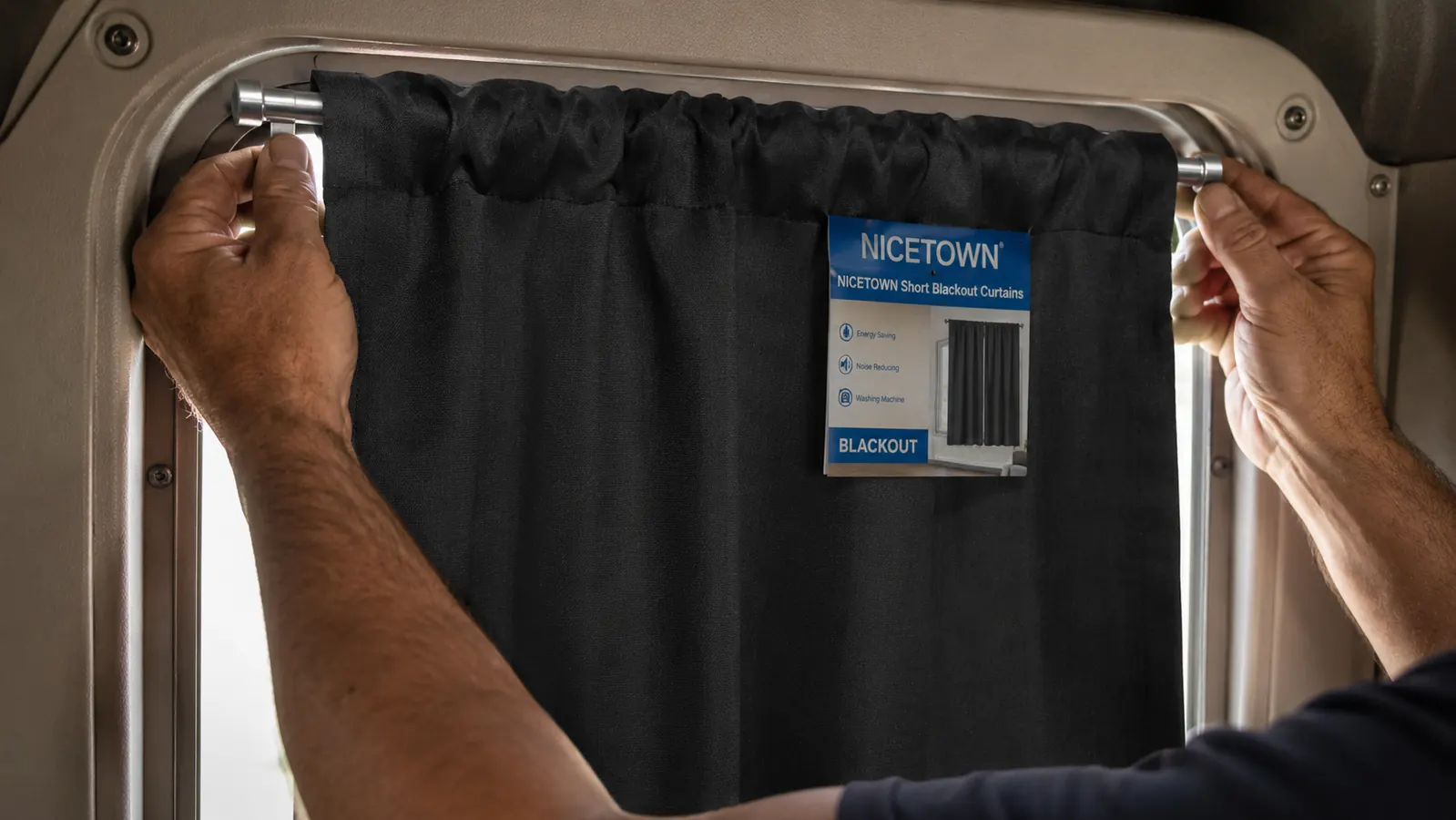
One thing to get right on installation: let the panel extend two to three inches past the window frame on each side and top. Light leaks around the edges if the panel only covers the glass exactly. The tension rod should sit behind the window trim, not in front of it. That small adjustment eliminates the gaps that let in the light stripes that wake you up at 8 AM.
Step 3: Handle the Bunk Divider Curtain Gap
The bunk divider curtain is the curtain between the sleeper berth and the main cab area. Every factory divider curtain I've seen has a gap at the top where it doesn't quite reach the ceiling. On a bright day, that gap acts like a light projector aimed directly at your face. If your windshield and door windows are letting in sun, all of it funnels through that top gap into the sleeping area.
Fix this before worrying about the windshield. The simplest solution is to extend your existing divider curtain upward. Buy a second curtain panel that overlaps the top of the existing one, mount it on its own tension rod seated against the ceiling, and let it drape down over the gap. You can also use blackout fabric tape to attach an extension strip directly to the existing curtain. Either way, the goal is no gap between the top of the curtain and the ceiling. When I sealed mine, it was like turning a dimmer from 30 percent down to about 5 percent in the sleeper.
The bunk divider gap acts like a light projector aimed at your face. Seal that before worrying about the windshield, and you'll notice it immediately.
Step 4: Block the Door Windows and Windshield
Once the porthole windows and divider gap are handled, address the front of the cab. The door windows and windshield let in a significant amount of ambient light that bounces around the cab interior and bleeds through the divider curtain even when you've sealed the gap. If you sleep six hours past sunrise in a spot with lot lights or east-facing exposure, the front windows matter.
For the windshield, a custom-fit foam sunshade is the cleanest solution. Get one cut to your truck's windshield dimensions rather than a universal-fit that leaves gaps. For the door windows, a second pair of NICETOWN panels on tension rods handles each door window the same way you handled the porthole windows. Yes, this means four curtain panels total in some setups. It's still under $50 in materials and none of it requires a hole in the cab.
If you're a company driver and covering the windows during a break feels like too much gear to store, at minimum put the windshield sunshade up. The windshield opening is large enough that even with good porthole coverage, you'll see visible brightness in the sleeper from cab ambient light on a sunny day.
Step 5: Add a Sleep Mask as Backup
A sleep mask costs four dollars. I resisted using one for years because I thought it was for people who couldn't handle the road. That was dumb. A contoured sleep mask eliminates the light sources you haven't dealt with yet, the ones you only discover when you're parked in an unexpected orientation or the lot next door turns on a new set of sodium vapor lights at midnight.
Get a contoured model, not the flat fabric kind. The contoured shape holds the mask off your eyes and doesn't press against your lids. That matters for comfort on a six-hour sleep. Throw it in the bunk, use it as a backup when you're somewhere you haven't blacked out for, and use it as a primary when you're dead tired and don't have time to set everything up before your restart.
The mask doesn't replace the curtain work. Your curtains handle the real darkness. The mask is your override for situations outside your control.
Step 6: Park With the Sun in Mind
This one costs nothing and it makes every other step work better. Before you shut down for a daytime sleep, take thirty seconds to think about where the sun is and where it will be in four to six hours. If you park with the driver side facing east at 10 AM, the sun will work its way around to the passenger-side porthole by 2 PM and then to the driver-side porthole by late afternoon. Rotating the truck 90 degrees on the lot so the front faces north keeps both porthole windows in shade longer.
Not every lot gives you this flexibility. When it does, use it. A truck positioned right cuts light exposure in half even before the curtains do their job. I've parked under a lot light pole before because the canopy shade from a fuel island awning blocked the low morning sun better than any other spot on the property. Think about light geometry the same way you think about backing into a spot: the extra minute of planning saves you trouble later.
Also worth noting: lot lights at truck stops tend to be positioned high and aimed down. They hit the roof of the cab more than the sides. If you're dealing with a lot light directly overhead, the curtains on the porthole windows are still doing their job. The real enemy with lot lights is the windshield, which faces up at an angle and catches overhead light directly. Another reason the windshield sunshade earns its place in the kit.
What Else Helps
Noise is the other thing that kills daytime sleeping in a semi, and light and noise usually come from the same direction: the outside world. Foam earplugs or a pair of noise-reducing earmuffs address the engine drone from idling neighbors. A white noise app on your phone set to low can also mask variable outside sound better than silence does, because your brain stops trying to identify each new noise and relaxes.
Temperature is the third factor. A blacked-out sleeper heats up faster in summer because the dark fabric absorbs heat. If you're running without APU, this is a real tradeoff. The NICETOWN panels have a thermal-insulated layer that reflects some heat back out, which helps, but it doesn't replace airflow. A 12V fan aimed at the bunk buys you meaningful comfort even on a hot day without idling the engine. Manage temperature at the same time you manage light and you'll stack all three conditions in your favor.
Finally, if you're new to day sleeping, give yourself two weeks before you decide your setup isn't working. Your circadian rhythm fights the schedule change hard for the first ten days. The setup matters but biology is slower to adjust. Stick with the full routine, keep the curtains up every time you park, and your body will eventually stop interpreting 10 AM sunlight as a signal to be awake.
The NICETOWN blackout panels are the single best place to start if daytime light is costing you sleep.
Under $25 for a two-pack, no-drill tension rod install, and the triple-weave fabric actually blocks light instead of just filtering it. Works in porthole windows, door windows, or anywhere you need real darkness. 4.5 stars from more than 46,000 buyers.
Amazon Check Today's Price on Amazon →